
Do Saltwater Pools Need Maintenance?
Yes. A saltwater pool still needs weekly care.
The salt system automates one job, making chlorine. It doesn’t balance pH, stop calcium scale, brush the walls, vacuum the floor or empty the baskets. That’s why salt pools on our routes get the same weekly pool service as traditional chlorine pools.
Salt pools are a great setup. The water often feels softer, and you don’t have to haul jugs of chlorine.
But the idea that a salt pool takes care of itself is one of the most common misunderstandings we hear. The salt cell replaces the chlorine jug. It doesn’t replace the checklist.
What a Salt System Automates (and What It Doesn’t)
A salt system automates chlorine production and nothing else. A salt chlorine generator passes salty water through a cell that converts some of the salt into chlorine. That steady, automatic output is the big advantage, and here’s how the work splits up:
| Task | Salt system handles it? |
|---|---|
| Producing chlorine | Yes, as long as salt level and cell are in good shape |
| Keeping pH in range | No, pH tends to rise and needs acid |
| Preventing calcium scale | No, scale is actually more likely |
| Stabilizer (CYA) level | No, still needs testing and adjusting |
| Brushing walls and steps | No |
| Skimming and vacuuming | No |
| Emptying baskets | No |
| Checking pump and filter | No |
Even the one task the system does handle needs a human check. Most salt cells work best when the water holds roughly 2,700 to 3,400 ppm of salt, and your cell’s manual will give the exact target. Too little salt and chlorine output drops. Too much and you can trigger error codes.
Stabilizer is the one people miss. According to Pool Research, salt pools do best with a CYA level of 60 to 80 ppm, compared with 30 to 50 ppm for pools using trichlor tabs. The cell makes chlorine slowly, so it needs more sunscreen for the sun. Push CYA past 100 ppm and chlorine gets less effective.
The chlorine output also has to be adjusted with the seasons. A setting that’s perfect in winter may be too low in July and too high in January, so someone still has to test and tune it.
The salt pool trade-off
You stop buying chlorine, but you start watching pH and scale more closely. That’s a good trade, as long as someone is actually watching.
pH Drift and Calcium Scale
A salt pool’s pH climbs steadily, so it needs regular acid to stay near 7.4 to 7.6. The chemistry that makes chlorine from salt also raises pH. Our guide to pool chemistry levels covers the ideal ranges.
High pH causes two problems. First, chlorine works less effectively, so the pool needs more of it. Second, calcium comes out of solution and forms scale.
Scale needs three things to show up:
- High pH
- High calcium hardness (200 to 400 ppm is the usual target)
- Warm water
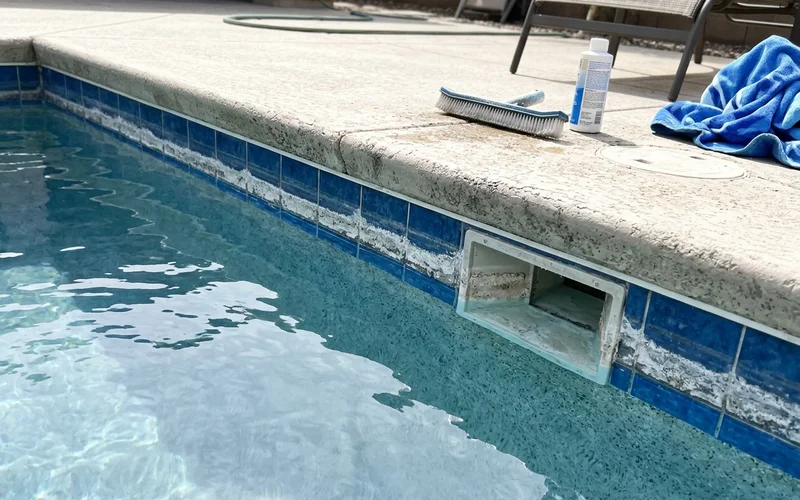
North Orange County checks the second box before you add a single chemical. Anaheim tap water often tests somewhere around 150 to 200 ppm hardness, depending on the blend of local groundwater and imported supply. So salt pools here are especially prone to white crust on the waterline tile and on the plates inside the salt cell. Scale on the cell reduces how much chlorine it can make.
Here’s a pro tip we pass along to customers. Acid washing a cell wears down its coating, so cleaning it more often than needed shortens its life. Many pool pros suggest checking the cell every three to four months, and sooner if you see buildup. The better fix is keeping pH and calcium in line so scale forms slowly in the first place.
Brushing, Vacuuming and Debris Still Matter
Yes, a salt pool still gets dirty. A salt system has no effect on leaves, dust or the film that builds on walls.
Here’s what still piles up without regular cleaning:
- Algae in corners and on steps, especially if chlorine output dips
- Leaves in baskets and on the floor
- Debris that clogs the filter and slows circulation
- Scale along the tile line, which brushing helps slow
Circulation matters more in a salt pool than most owners realize. The pump has to run long enough to move water through the salt cell, since the cell only makes chlorine when water is flowing. A clogged basket or dirty filter can quietly cut chlorine output.
How Weekly Service Handles Salt Pools
Weekly service covers everything the salt system doesn’t. On a visit to a salt pool, we:
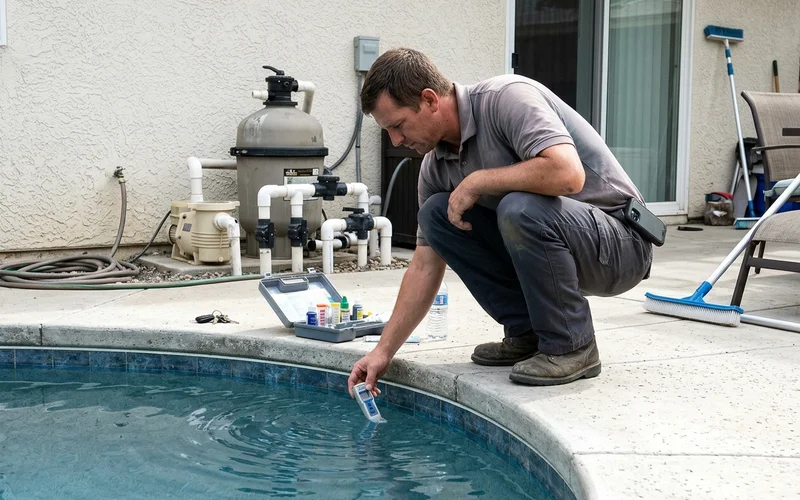
- Test free chlorine, pH, alkalinity, stabilizer, calcium and salt level
- Add acid to bring pH back into range
- Adjust chlorine output if the water is running high or low
- Skim, vacuum and brush the pool
- Empty skimmer and pump baskets
- Brush the tile line to slow scale
- Check pump, filter and flow so the cell gets proper circulation
We provide routine weekly care for salt pools, but we don’t repair or replace salt cells. If your cell stops producing or shows an error, we’ll tell you and point you toward a specialist. Everything else, from chemistry to cleaning to pump and filter repair, we handle.
A salt pool with weekly care is one of the easiest pools to own. A salt pool left on its own usually ends up with high pH, scale and a cell that can’t keep up.
If you have a salt pool in Anaheim or nearby, ask us about salt pool weekly service. We’ll test your water, check your cell’s circulation and set up a route that keeps everything in range.