
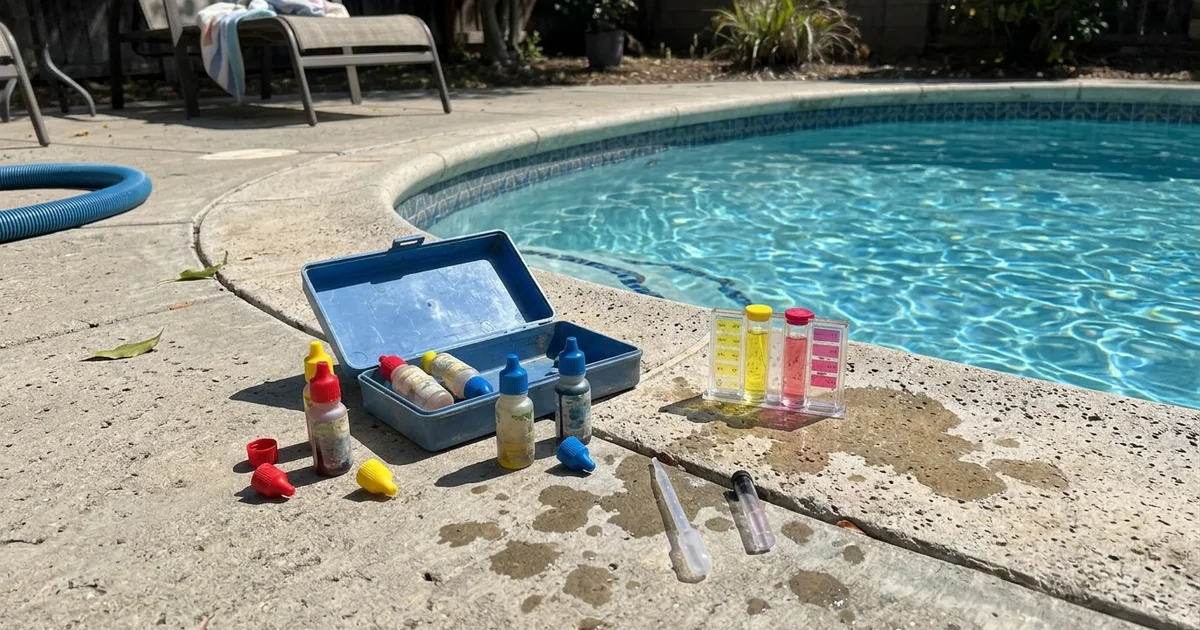
Pool Chemistry Levels at a Glance
Most pool problems trace back to five numbers. Free chlorine, pH, total alkalinity, cyanuric acid (stabilizer) and calcium hardness make up your core pool chemistry levels.
Keep them in range and the water stays clear, safe and easy on your plaster and equipment. Let them drift and you get green water, scale, etched plaster or corroded parts.
Testing and adjusting these readings is the core of chemical balancing on every visit we make.
Public health guidance points the same way. The CDC’s Model Aquatic Health Code calls for at least 2 ppm of free chlorine when stabilizer is in the water and keeps pH between 7.0 and 7.8.
Here are the target ranges we work toward for a residential plaster pool:
| Reading | Target range | What it does |
|---|---|---|
| Free chlorine | About 2 to 4 ppm (scaled to CYA) | Kills bacteria and algae |
| pH | 7.4 to 7.6 ideal (7.2 to 7.8 acceptable) | Controls how acidic or basic the water is |
| Total alkalinity | About 80 to 120 ppm | Buffers pH so it doesn’t swing |
| Cyanuric acid (CYA) | About 30 to 50 ppm (higher for salt pools) | Protects chlorine from sunlight |
| Calcium hardness | About 200 to 400 ppm | Keeps water from attacking plaster |
The chlorine range moves with your stabilizer. A common rule of thumb from the Trouble Free Pool community is a minimum free chlorine of about 7.5% of your CYA, so 40 ppm of CYA needs at least 3 ppm of chlorine.
These are general guidelines. Salt pools, pebble finishes and pools with spas can call for slightly different targets, and the readings work together, so changing one often shifts another.
What Each Reading Means in Plain English
Each of the five readings does one job, and each one fails in its own way. Here’s what they mean in plain terms:
- Free chlorine is the sanitizer that’s available to work. Sunlight, heat, swimmers, leaves and rain all use it up. When it runs low, algae and bacteria move in.
- pH measures whether the water leans acidic or basic. Low pH water is aggressive and eats at plaster, grout and metal. High pH makes chlorine sluggish and pushes calcium out of the water as scale.
- Total alkalinity acts like a shock absorber for pH. If it’s too low, pH bounces around. If it’s too high, pH keeps drifting up no matter how much acid you add.
- Cyanuric acid is stabilizer. Outdoor pools in Southern California need some, or the sun destroys chlorine in hours. Too much makes chlorine slow to act, and it only leaves the water by draining.
- Calcium hardness is how much dissolved calcium the water holds. Plaster is made with calcium, so water that’s too soft will try to dissolve it. Water that’s too hard leaves crust on the tile.
Stabilizer deserves a closer look because it sneaks up on people. Trichlor tablets add about 0.6 ppm of CYA for every 1 ppm of chlorine they release. A pool on tablets all summer can climb past 80 ppm without anyone noticing.
Why the numbers work together
Pool pros use the Langelier Saturation Index (LSI) to combine pH, alkalinity, calcium and temperature into one number. A balanced LSI sits close to zero, roughly between -0.3 and +0.3, which means the water neither eats plaster nor drops scale.
What Imbalance Does to Your Pool
Bad chemistry costs you money, and the damage is usually slow and quiet. Here’s what we see most often:
- Etched plaster. Low pH or low calcium dissolves the surface, leaving it rough and pitted. Rough plaster grabs algae and stains.
- Calcium scale. High pH and high calcium leave white crust at the waterline and inside heaters and pipes. See our guide on calcium scale on tile.
- Corroded equipment. Aggressive water attacks metal parts in pumps, heaters and fittings, shortening their life.
- Algae and cloudy water. Low chlorine or high stabilizer lets algae get ahead.
- Uncomfortable swimming. Off-balance water can sting eyes and dry out skin.
Etching is the one to watch. You can’t undo it with a chemical, and fixing it usually means resurfacing, which costs far more than a year of steady testing.
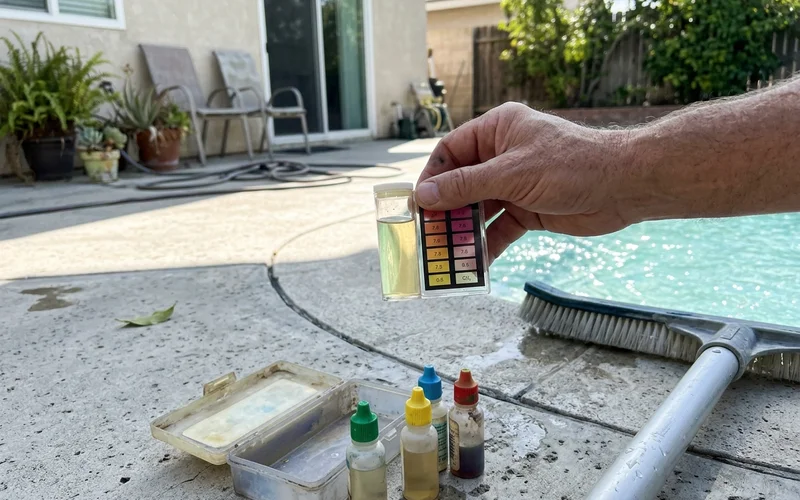
Why Weekly Testing Matters Here
Weekly testing matters in Anaheim because our water and our weather both push chemistry off balance fast. Local tap water is already hard, and published figures for Anaheim run from roughly 8 to 12 grains per gallon, or about 135 to 205 ppm. Our heat then drives fast evaporation, and every top-off adds more minerals.
Here’s how that plays out through the year:
- Calcium hardness and dissolved solids slowly climb as water evaporates and gets replaced.
- Chlorine burns off quickly under strong sun.
- Algae grows faster in summer heat.
That’s why chemistry can’t be a once-a-month job. A pool that tests perfectly on Monday can be low on chlorine and high on pH by Friday during a heat wave.
Weekly testing catches the drift before it becomes a problem. A professional also tracks the trend over months, which is how you spot rising stabilizer or calcium early enough to correct it without draining.
If you’d rather not keep up with test kits, chemical runs and calculations, weekly service handles it. We test and balance every visit and let you know when something needs attention. Call Anaheim Pool Cleaners to set up a weekly route, and we’ll get your pool chemistry levels dialed in from the first visit.