
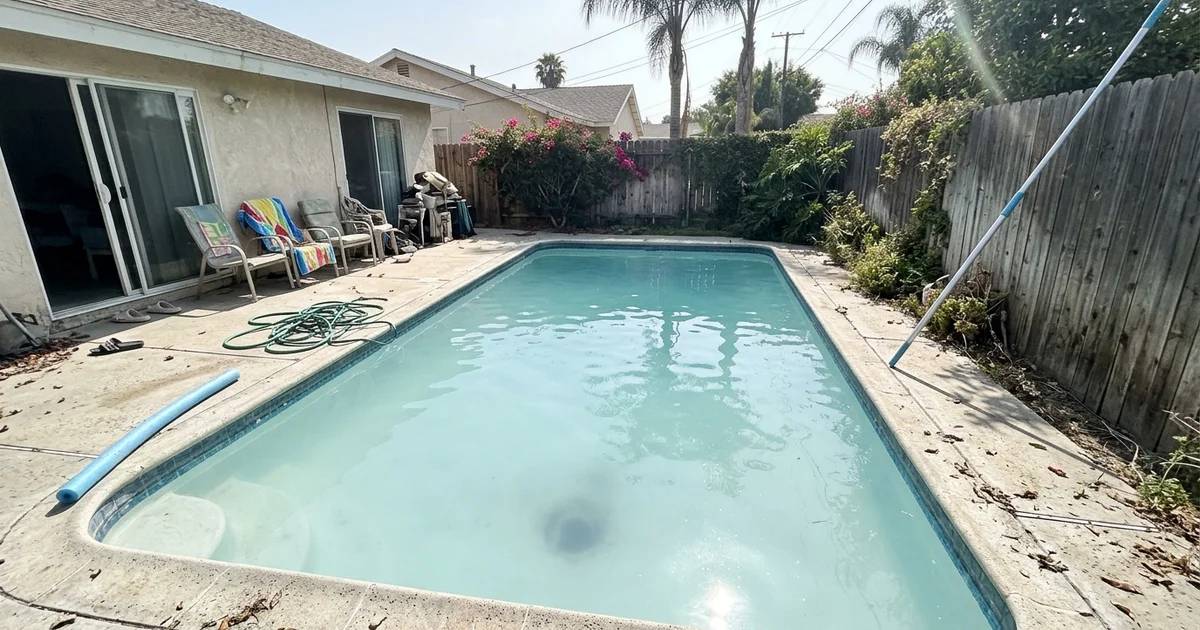
Why Is My Pool Water Cloudy?
Cloudy pool water has two families of causes: chemistry and filtration. Either the water chemistry is out of balance and something is coming out of solution, or the filter isn’t removing fine particles fast enough. Sorting out which one you have is the key to fixing it, and it’s one of the first things we check on a weekly pool service visit.
The good news is that cloudy water usually comes before green water. Catch it now and it’s often a fast fix.
So here’s how we’d work through it: the chemistry readings that cause haze, the filtration problems that let it linger, a few quick tests, and the signs that your equipment needs a pro.
Chemistry Causes of Cloudy Water
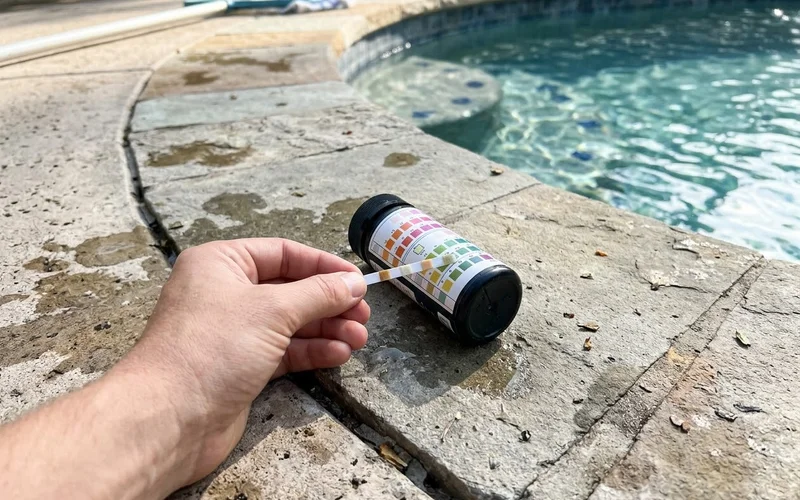
Start with a test kit or test strips. If any of these readings are off, chemistry is your likely cause:
- High pH. Once pH climbs above about 7.8, calcium can start to come out of solution and haze the water. Most guides put the sweet spot at 7.4 to 7.6. Salt pools and freshly plastered pools drift high often.
- High calcium hardness. North Orange County fill water is hard. Combined with high pH and warm water, high calcium can turn the water milky and leave scale on the tile. The usual target is 200 to 400 ppm.
- High total alkalinity. Alkalinity that’s too high keeps pushing pH upward, which feeds the same calcium problem. Most guides aim for roughly 100 to 150 ppm.
- Low sanitizer. When free chlorine drops, fine organic matter and early algae cloud the water before you see any green. The CDC recommends at least 1 ppm free chlorine, and 2 ppm if you use cyanuric acid.
- High cyanuric acid. Too much stabilizer makes chlorine sluggish, so the water looks dull even when chlorine reads normal. Most pros keep it around 30 to 50 ppm.
What the test tells you
If chlorine is low, raise it first. If pH and alkalinity are high, bring them down. If everything tests in range and the water is still hazy, your filter is the likely culprit.
One pro tip on shocking: shock raises pH, so test first. Pools that are already high on pH or alkalinity often look worse after treatment, which is why a cloudy pool after shock is so common. Bring alkalinity and pH into range before you add shock, and you’ll skip a lot of frustration.
Filtration Causes of Cloudy Water
Perfect chemistry can’t clear water that isn’t being filtered. Look for these problems:
- Short pump run time. The whole pool needs to pass through the filter at least once a day. Summer usually needs longer run times than winter.
- Dirty filter media. A clogged filter slows flow. Check the pressure gauge, and if it reads well above its clean baseline, the filter needs cleaning. Our guide on how often to clean your filter explains the 8 to 10 PSI rule of thumb.
- Damaged filter media. A torn cartridge, a broken DE grid or channeled sand lets fine particles slip through. The pressure may even look normal.
- Pump problems. A pump that’s losing prime, cavitating or running weak moves less water than it should.
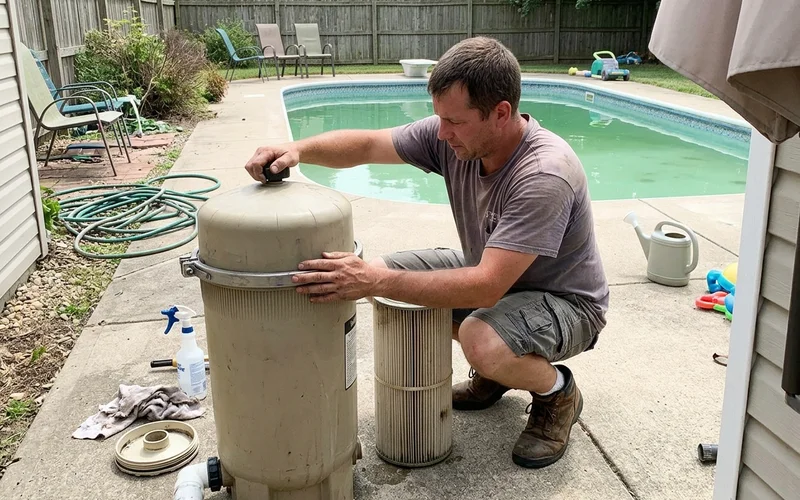
Damaged media is the one homeowners miss most. If your gauge looks fine but the water stays hazy, open the filter and look for torn pleats or broken grids.
Quick Tests You Can Run
Before buying chemicals, run through this list. It takes about ten minutes and tells you where to start.
| Check | What you’re looking for | What it suggests |
|---|---|---|
| Free chlorine | Below about 2 ppm | Sanitizer problem, raise chlorine |
| pH | Above about 7.8 | Calcium coming out of solution |
| Filter pressure | Well above clean reading | Clogged filter, clean it |
| Filter pressure | Normal but water hazy | Possible torn or damaged media |
| Pump run time | Under 8 hours in summer | Not enough filtration |
| Main drain | Can’t see it clearly | Don’t swim until it clears |
Here’s how to clear cloudy pool water once you’ve found the cause. Fix the chemistry first, clean the filter if the pressure is high, then shock the pool and run the pump continuously. That clears many cloudy pools within a day or two.
Some haze after shocking is normal. Swim University and other pool guides put routine post-shock cloudiness at 24 to 48 hours, while dead algae in a formerly green pool can take 3 to 7 days to filter out. If the water clears and then turns cloudy again, an underlying problem keeps coming back.
When Cloudy Water Points to an Equipment Problem
Sometimes cloudy water is the first sign that equipment is failing. A filter that won’t hold pressure after cleaning, a pump that hums or rattles, or a pool that clouds up again a few days after being cleared all point to the equipment pad. Torn cartridges and broken DE grids are common in older filters, and a struggling pump can’t move enough water to keep up in summer.
That’s when it’s worth having a pro look at it. We test the water, check the pump, motor and filter, and tell you whether the fix is chemistry, a filter cleaning or a repair. If you’d rather not chase cloudy water every week, weekly service keeps chemistry and filtration on track so the problem stays gone.
Need help finding the cause? Schedule a water test and we’ll sort out whether it’s chemistry or equipment.