What Does Pool Equipment Repair Include?
Is your pump suddenly loud, or is the water going cloudy? Chances are the trouble is sitting on your equipment pad.
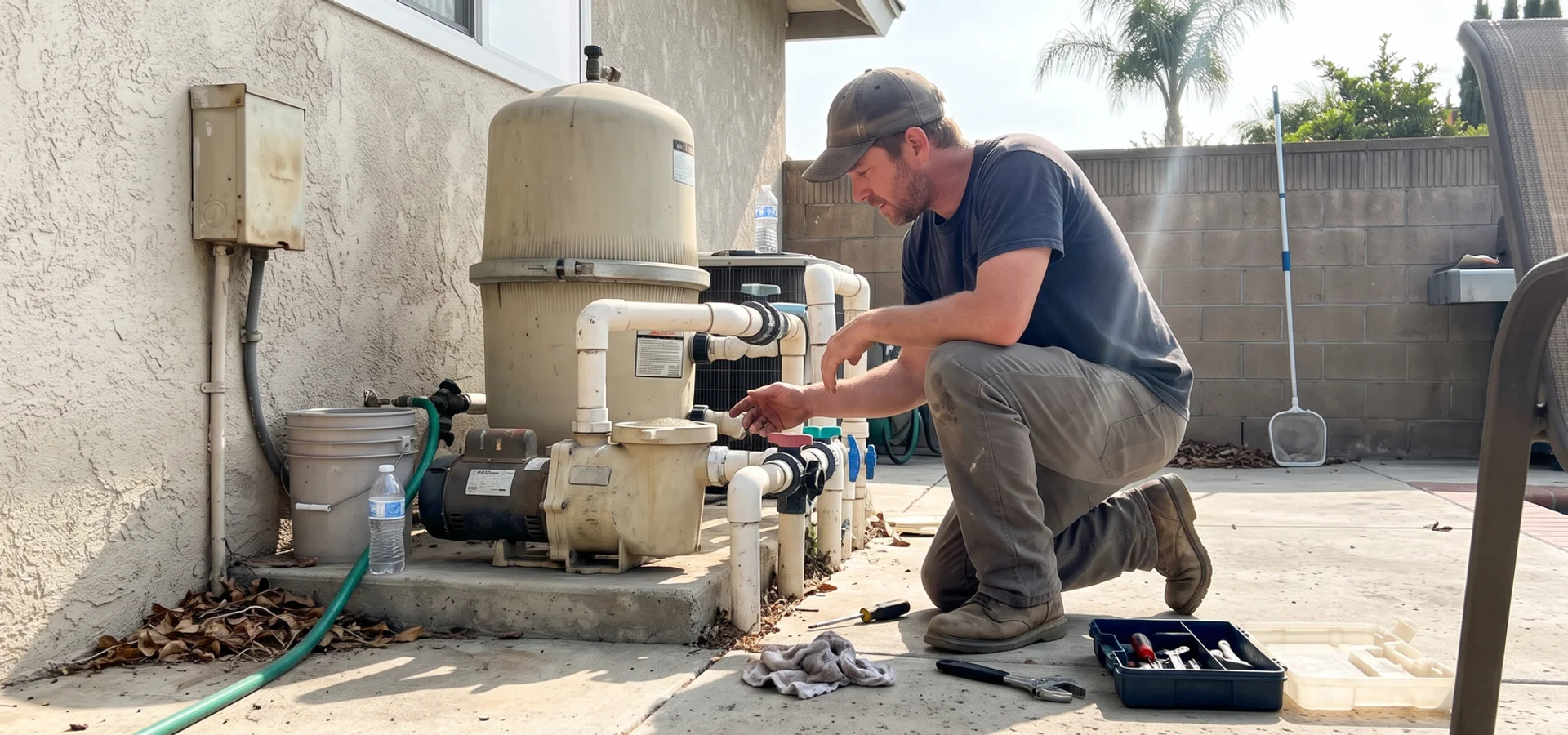
Pool equipment repair covers everything that moves and cleans your water: the pump, the motor that drives it, the filter, and the valves and plumbing that tie them together. When any one of those fails, circulation slows or stops. Sanitizer can’t reach the whole pool, and the water starts turning within days.
In Anaheim’s summer heat, that can happen over a single weekend.
We’ve seen it plenty of times, and most of these problems are fixable when you catch them early. Here’s how we sort out what’s wrong and what it’ll take to fix it.
We Inspect the Whole System First
Our approach is simple: test before we touch a single part. The same symptom can have very different causes.
- A noisy pump: a worn bearing, cavitation from a clogged impeller, or a starved pump strainer basket
- A pump that won’t start: a dead motor capacitor, a seized motor, or a tripped GFCI breaker
Swapping parts until something works is how pool owners end up paying twice. Testing first tells us what actually failed.
Repair or Replace? You Get the Straight Answer
Once we know the cause, we tell you plainly which way to go. When it’s a close call, you get both prices side by side.
| Situation | Usually the better call |
|---|---|
| Newer pump with a failed mechanical shaft seal or capacitor | Repair |
| Older single-speed pump with a tired TEFC motor and repeat failures | Replace |
Replacement is often worth it because of energy use. The California Energy Commission says variable-speed pool pumps can cut the electricity needed to circulate and filter your pool by up to 80%.
What We Repair and Replace
We work on pumps, motors and filters of every common type, including cartridge, sand and DE filters. We also fix the accessories on the pad.
Replacement pumps are selected to meet California Title 20 pool pump efficiency standards. Under those rules, replacement pool pump motors of 0.5 horsepower or more must be variable speed. We also keep the Title 24 building energy code in mind on renovations.
Every job starts with a free, no-obligation estimate.
Common Problems We Solve
Pump screeching, grinding or humming
Each sound points to a different culprit:
- High-pitched screech: almost always worn motor bearings
- Rattle like gravel: usually cavitation, where the impeller is starved for water because of a clogged basket, a blocked impeller or a low water level
- Hum with no spin: a failed capacitor or a seized motor
A quick tip: check the basket and the water level first. It takes two minutes and sometimes solves the rattle on the spot. Our guide on why a pool pump makes a loud noise breaks down each sound.
Pump won’t prime or keeps losing prime
Air in the suction line keeps the pump from pulling water. The most common causes are a dry or cracked pump strainer basket and lid O-ring, a loose union, a leaking valve or a water level below the skimmer.
On hillside lots in Anaheim Hills, long suction runs make this more likely. If you reseat the lid O-ring yourself, use a silicone-based lubricant. Petroleum jelly can swell and damage rubber seals.
High filter pressure or poor flow
Start with your filter pressure gauge (PSI). Note the reading right after a clean, then watch for it to climb. Pentair’s guidance is to clean the filter once the gauge reads about 10 PSI above that clean baseline, and some pool pros act at 8.
If cleaning doesn’t bring the pressure back down, the filter is clogged, the media is worn out or something downstream is restricted. The cartridge, sand or DE grids may need replacing. On sand filters we also check the multiport backwash valve for a leaking spider gasket.
Breaker trips or the motor won’t start
A pump that trips the GFCI breaker can have a shorted motor winding, water in the motor or a wiring fault. Because water and electricity are involved, this one isn’t a DIY job.
Shut it off and call us.
When Should You Call for Pool Equipment Repair?
Call us when you notice any of these:
- A new noise from the pump
- Water leaking under the pump
- A filter gauge stuck high after cleaning
- A pump that won’t prime
- Cloudy water that doesn’t clear with chemistry
- A breaker that keeps tripping
Catching a failing seal or bearing early often means a small repair instead of a burned-out motor.
If you’re on our weekly service, your tech checks the pad every visit and flags problems before they turn into a weekend emergency. Not on weekly service yet? Call Anaheim Pool Cleaners today for your free, no-obligation estimate on pool equipment repair, and we’ll get your water moving again.