
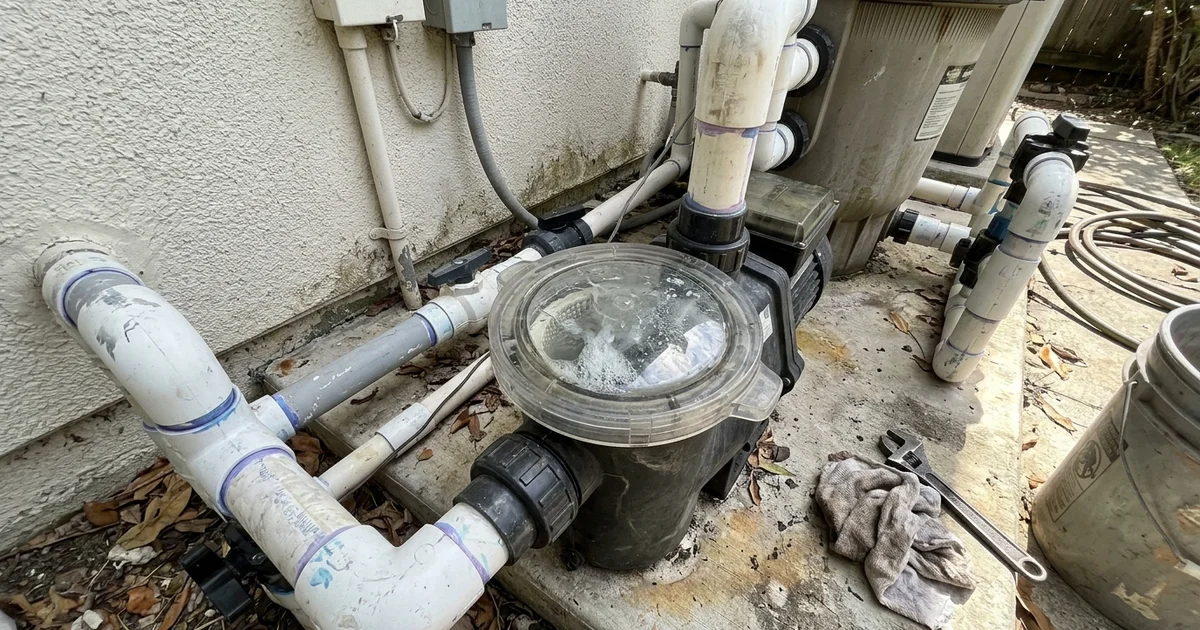
Why Your Pool Pump Won’t Prime
A pool pump that won’t prime is pulling air instead of water. Priming means filling the pump and suction lines with water so the impeller can move it. When air sneaks in, or water can’t reach the pump fast enough, the motor spins but little or no water moves.
If you’re dealing with a pool pump not priming, you’re in good company. It’s one of the most common calls we get for pool equipment repair, and the cause is usually on a short list.
A pool pump losing prime tends to come down to one of five things: low water, a clogged basket, an air leak, a clogged impeller, or a cracked fitting. We’ll go through them in the order we check them on a service call.
Low Water Level and Clogged Baskets
Start with the simple stuff, because it fixes more pumps than you’d expect. The water should sit at least halfway up the skimmer opening. Below that, the skimmer gulps air whenever the pump surges.
- Water level too low. Evaporation in an Orange County summer and Santa Ana wind events can drop a pool an inch or more in a few days.
- Full skimmer basket. A packed basket restricts flow and lets air in.
- Full pump strainer basket. Same problem, right at the pump.
- Closed or partly closed valve. A suction valve turned the wrong way starves the pump.
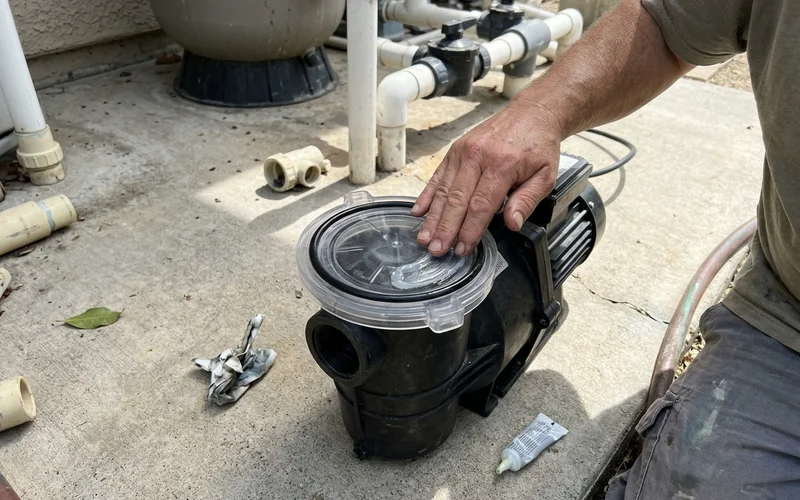
Fixing these is often all it takes. Turn the pump off, top off the water, empty both baskets and check the valves. Then fill the pump strainer pot with water before you restart.
Air Leaks on the Suction Side
If the basics check out and the pump still won’t hold prime, air is likely getting into the suction side. That’s the plumbing between the pool and the pump, where the pump pulls a vacuum. Even a tiny gap can let air in.
| Leak point | What to look for |
|---|---|
| Pump lid O-ring | Dry, cracked, flattened or dirty O-ring |
| Pump lid | Cracked lid or one that isn’t seated tightly |
| Suction-side unions | Loose or worn union O-rings |
| Valves | Worn valve seals letting air in |
| Drain plugs | Missing or loose plug O-rings on the pump |
| Fittings at the pump inlet | Cracked threaded fittings |
The lid O-ring is the usual suspect. Our tip: swap it for a new one even if the old one looks fine. A worn ring can pass a visual check and still leak once the pump pulls a vacuum. Lubricate the new ring with a silicone-based pool lubricant, since petroleum jelly can swell and break down the rubber.
A quick tell
If you see a steady stream of bubbles coming back into the pool from the return jets, air is getting in somewhere before the pump. Air collecting in the clear lid or pump basket points to the same problem.
Clogged Impeller and Cracked Fittings
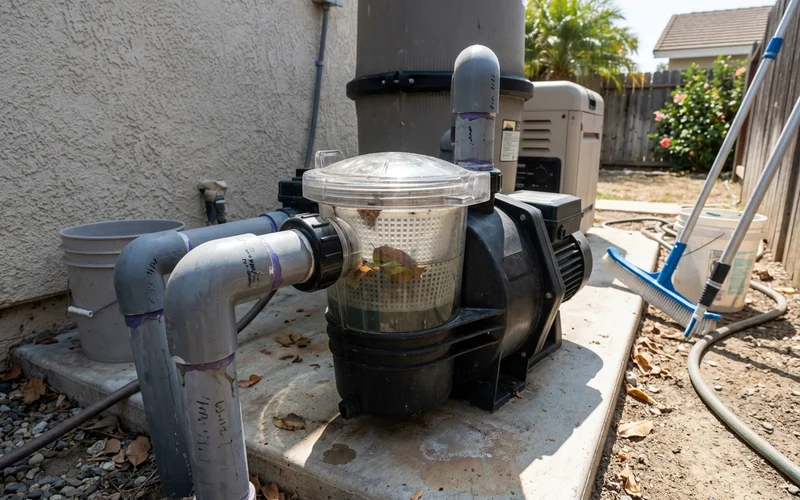
A clogged impeller or a cracked fitting can each keep a pump from priming. Debris that gets past the basket can jam the impeller vanes, so the pump can’t move water efficiently. It often sounds rough or rattly too.
Clearing it means opening the pump, so it’s a job for a technician. Our guide on loud pool pump noises covers how a clogged impeller sounds.
Cracked fittings and pipes are the other culprit, especially on older equipment pads that sit in full sun. Years of UV exposure make plastic brittle. A hairline crack on the suction side can be enough to keep a pump from priming.
The Risk of Running a Pump Dry
Don’t let a pump run for long without water. Most pros say a minute or two is the limit before damage starts. A dry pump heats up quickly, and that heat can warp the strainer basket and melt the lid or fittings. It can also destroy the mechanical shaft seal and damage the motor.
A failed shaft seal turns a cheap air leak into a much bigger repair. If the pump hasn’t caught prime after a few minutes, turn it off and find out why before you try again.
When It’s Time to Call
Call us if the pump still won’t prime after you’ve checked the water level, baskets and valves. Call if it loses prime overnight every night, or if you see water leaking around the pump.
We pressure-check the suction side, find the leak and fix it. Re-priming the pump and leaving the cause in place just sets you up for the same problem next week. On hillside lots in Anaheim with long suction runs, that diagnosis matters even more.
If your pool pump is not priming and you’ve run out of easy fixes, contact Anaheim Pool Cleaners and we’ll get it moving again.