
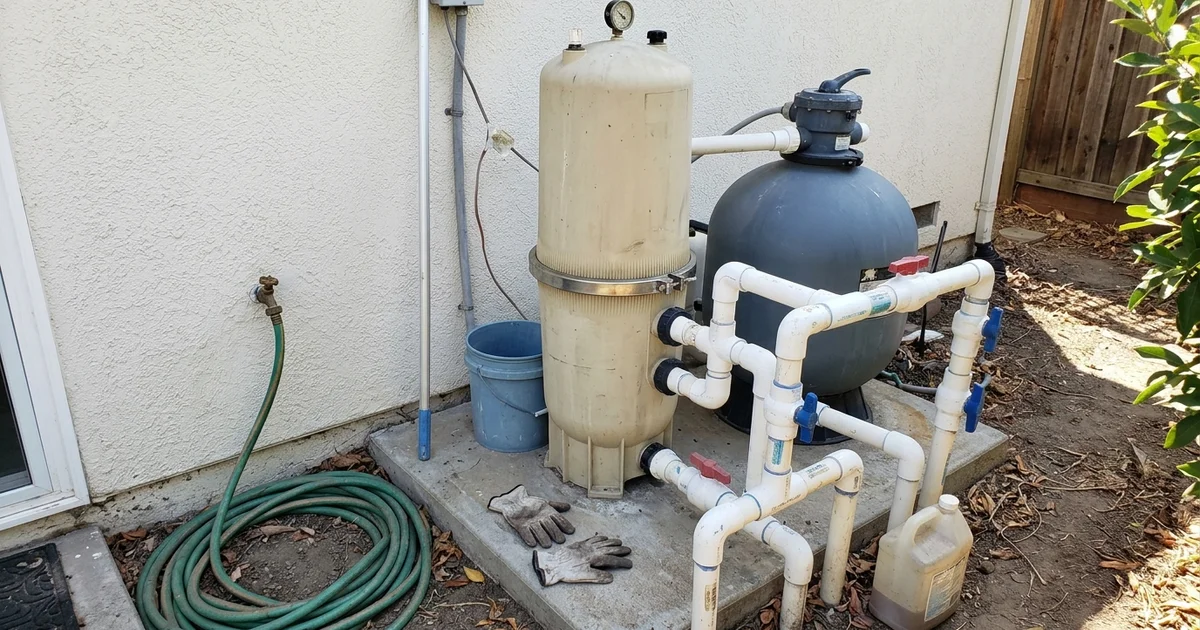
Every pool filter does the same job: it traps dirt, debris and dead algae before they cloud the water. The real question in a cartridge vs sand vs DE filter decision is how fine you want the filtering, how much work you’ll do, and how much water you’re willing to spend.
Each type works well when it’s sized right and kept up. If a replacement is coming as part of pool equipment repair, here’s how we compare them.
We’ve swapped out plenty of filters around Anaheim, and the best pool filter type usually comes down to your debris and your schedule. It rarely comes down to the brand.
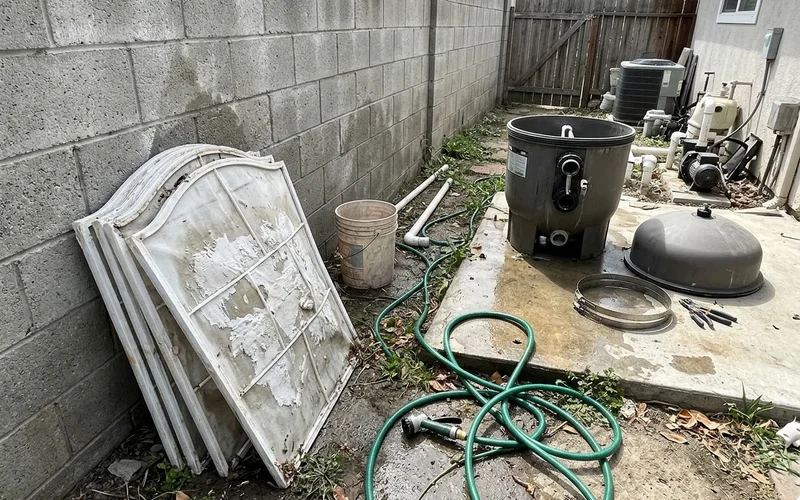
How Each Filter Works
Cartridge filters push water through pleated fabric cartridges. Dirt collects on the fabric, and you pull the cartridges and hose them off when the pressure gauge climbs.
Sand filters push water through a bed of special filter sand. Dirt gets trapped in the sand, and you clean it by backwashing. That reverses the flow and sends the dirty water out a waste line.
DE filters use grids coated with diatomaceous earth, a fine powder made from fossilized algae. The powder catches very small particles. You backwash, add fresh DE, and strip the grids down for a full cleaning now and then.
Side-by-Side Comparison
Sand is the coarsest filter at roughly 20 to 40 microns. Cartridge is finer, typically around 10 to 20 microns. DE is the finest, catching particles down to about 3 microns or less. A micron is one-millionth of a meter, so lower numbers mean clearer water.
| Factor | Cartridge | Sand | DE |
|---|---|---|---|
| Filtration fineness | Fine (about 10 to 20 microns) | Coarser (about 20 to 40 microns) | Finest (about 3 microns or less) |
| Routine cleaning | Remove and hose cartridges | Backwash | Backwash and recharge DE |
| Water used for cleaning | Very little | More (backwash) | More (backwash) |
| Maintenance effort | Moderate | Low | Highest |
| Media lifespan | Cartridges 2 to 3 years | Sand 5 to 7 years | Grids several years |
| Upfront cost | Moderate | Lower | Higher |
The local angle
In a region where water is precious and every refill adds minerals, cartridge filters have an edge because they don’t backwash pool water to waste.
Maintenance and Water Use
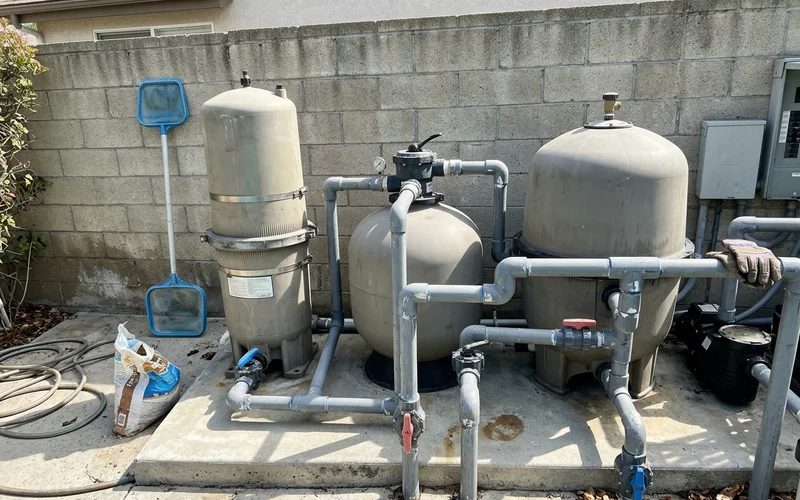
Sand filters are the easiest to live with. When the pressure gauge reads about 8 to 10 psi above its clean starting number, you backwash for a couple of minutes. The catch is water: a single backwash can send roughly 100 to 300 gallons down the drain, depending on filter size. Refilling with hard tap water then adds calcium back in.
Cartridge filters skip backwashing, so they save that water. Someone does have to open the tank and rinse the pleats, though. Plan on new cartridges every two to three years.
DE filters give the clearest water but ask the most of you. Here’s what that looks like:
- Backwash and recharge: after each backwash, you add fresh DE through the skimmer.
- Grid teardown: the grids need a full cleaning once or twice a year.
- Grid condition: torn grids can send DE back into the pool, so inspect them each time.
If you’re weighing a DE vs cartridge filter and don’t want the extra chores, cartridge is usually the calmer choice.
Fit for Local Debris and Hard Water
North Orange County pools deal with leaves, wind-blown dust and hard water. Here’s how that plays out:
- Heavy debris (trees, hillside brush): a larger cartridge or a sand filter handles the load with less frequent cleaning.
- Fine dust after Santa Ana winds: DE and cartridge filters catch more of it.
- Water conservation: cartridge filters avoid backwash waste.
- Calcium in the media: hard water can calcify sand and coat cartridge pleats. Pool industry guides report that scaling can cut a cartridge’s life from two or three years to about 12 to 18 months.
Sand is somewhat more forgiving of scale than pleated media. It still needs regular backwashing to stay loose.
Replacement Considerations
You can usually stay with the same filter type or switch. Switching may mean changing plumbing and valves, so do it when it fixes a real problem, like wasted backwash water or water that won’t clear.
Size matters just as much. The filter must be rated for your pump’s flow rate, and an undersized one clogs fast. Our guide on how often to clean your pool filter covers cleaning intervals for each type.
We’ll recommend the type and size that fit your pool, your pump and how much time you want to spend on upkeep. Reach out to our team for a filter check, and we’ll help you pick the right one before you buy.