
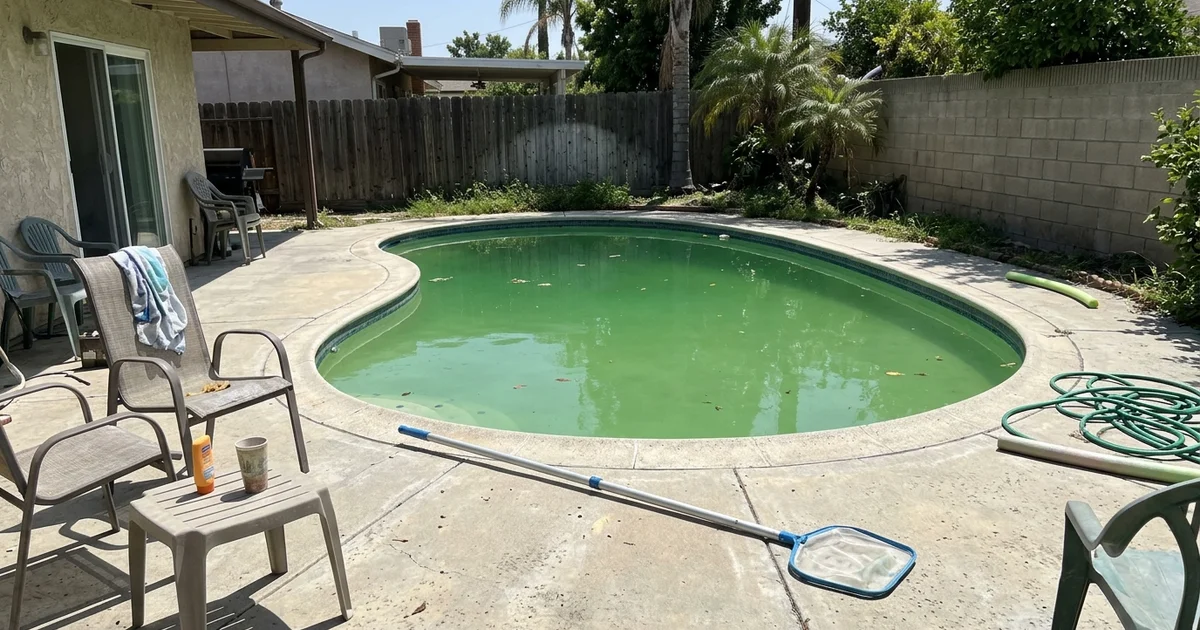
Why Is My Pool Green?
A pool turns green because algae is growing faster than your sanitizer can kill it. That almost always traces back to one of four things: free chlorine dropped too low, cyanuric acid (stabilizer) climbed too high, circulation slowed down, or the filter stopped doing its job.
Usually it’s a mix. In Anaheim’s summer heat, a pool can go from clear to cloudy green in a weekend once the chlorine runs out.
If you’re on a steady pool service in Anaheim schedule, green water usually means something changed between visits. Think heat wave, party, storm or equipment problem.
If you care for the pool yourself, the chlorine has probably been drifting low for a while.
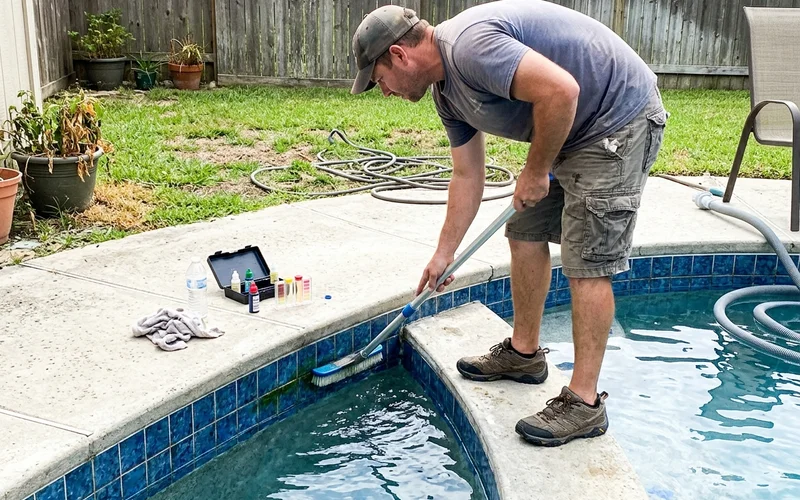
Here’s what each cause looks like:
- Low free chlorine. Free chlorine is the active sanitizer, and sun, heat, swimmers, leaves and rain all use it up. The CDC advises keeping it at 1 ppm or higher in a pool, and algae takes over once it nears zero.
- High stabilizer (CYA). Cyanuric acid protects chlorine from sunlight, but too much makes chlorine slow to act. A common rule from the Trouble Free Pool community is that free chlorine should sit at no less than 7.5% of your CYA level. At 100 ppm CYA, that means at least 7.5 ppm chlorine, far above a typical 2 to 3 ppm reading. Pools that use stabilized chlorine tablets for years often end up here.
- Poor circulation. A pump that runs too few hours, a clogged pump strainer basket or a failing motor leaves dead spots. Algae starts there first, often in corners and on the steps.
- Dirty or failing filter. A clogged or torn filter can’t remove algae and debris. The water stays cloudy and green even after you add chlorine.
The quick test
Test free chlorine and pH before you add anything. If chlorine reads near zero, you’ve found the main problem. If chlorine reads normal and the pool is still green, look hard at stabilizer levels and your filter.
How a Green Pool Gets Cleared
Clearing a green pool takes a process, not a single dose of chemicals. If you’re wondering how to clear a green pool, a professional green-to-clean visit follows roughly these steps:
- Test the water. Check free chlorine, pH, alkalinity and cyanuric acid so the treatment matches the problem.
- Remove debris. Skim leaves and empty the skimmer and pump baskets so the pump can pull full flow.
- Shock the pool. Raise chlorine high enough to kill algae, based on your stabilizer level. The Trouble Free Pool “SLAM” method sets the target at 40% of CYA, so a pool at 50 ppm CYA needs 20 ppm free chlorine. Higher CYA means more chlorine.
- Brush everything. Brushing walls, steps and floor breaks up algae so the chlorine can reach it.
- Run and clean the filter. Run the pump continuously. Dead algae clogs the filter fast, so it usually needs cleaning or backwashing more than once.
- Vacuum and rebalance. Once the water clears, vacuum the settled debris. Then bring pH, alkalinity and calcium back into range.
Shock at dusk when you can. Sunlight burns off chlorine, so an evening dose gets a full night to work.
| Pool color | What it usually means | Typical recovery |
|---|---|---|
| Light green, can see the floor | Early bloom, chlorine recently ran out | About 1 day with shock, brushing and filtration |
| Medium green, cloudy | Established algae, filter working hard | 1 to 3 days, several filter cleanings |
| Dark green, can’t see the floor | Heavy bloom, often with debris on the bottom | 3 days or more, debris removal first |
When Algae Is Past Routine Treatment
Most green pools recover with chlorine, brushing and filtration. A few don’t, and these are the cases we see most:
- Black algae. It grows in dark spots that root into plaster, and it comes back even after the pool looks clear.
- Lingering stains. Pools that sat green for months can leave marks in the plaster once the water clears.
- Equipment failure. If the pump stopped or the filter failed, fixing the chemistry alone won’t keep the water clear.
For the first two, the plaster itself needs attention. A chlorine wash on the drained pool handles many organic stains. Deeply rooted black algae or mineral staining may need an acid wash. Our guide on acid wash vs chlorine wash explains how to tell which one fits.
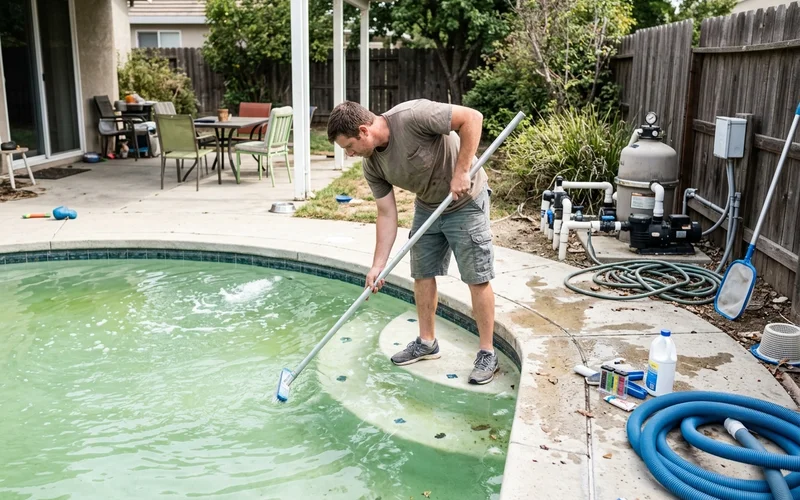
For the third, we check the pump, motor and filter during every green-pool cleanup. That way the problem doesn’t come right back.
How to Keep Your Pool From Turning Green Again
Prevention is far easier than recovery. In inland Southern California, that means:
- Test and balance every week. Check free chlorine, pH and stabilizer at least weekly, and more often during heat waves.
- Run the pump long enough. Summer needs longer run times than winter. Cutting hours to save power is a common cause of green pools.
- Keep baskets and the filter clean. Restricted flow means poor circulation and weak filtration.
- Watch stabilizer levels. If CYA climbs too high, partial draining is often the only fix. Switching away from stabilized tablets helps stop it from creeping back up.
- React to weather. Heat waves, rain and Santa Ana winds all spike chlorine demand.
Weekly service covers all of this for you. Your tech tests and balances the water, brushes, skims, empties the baskets and checks the equipment. Small changes get caught before they turn the pool green.
If you’re still asking why is my pool green right now, don’t wait for it to get darker. The faster it’s treated, the faster and cheaper it is to clear. Book a green pool cleanup and we’ll get your water back to clear and safe.