
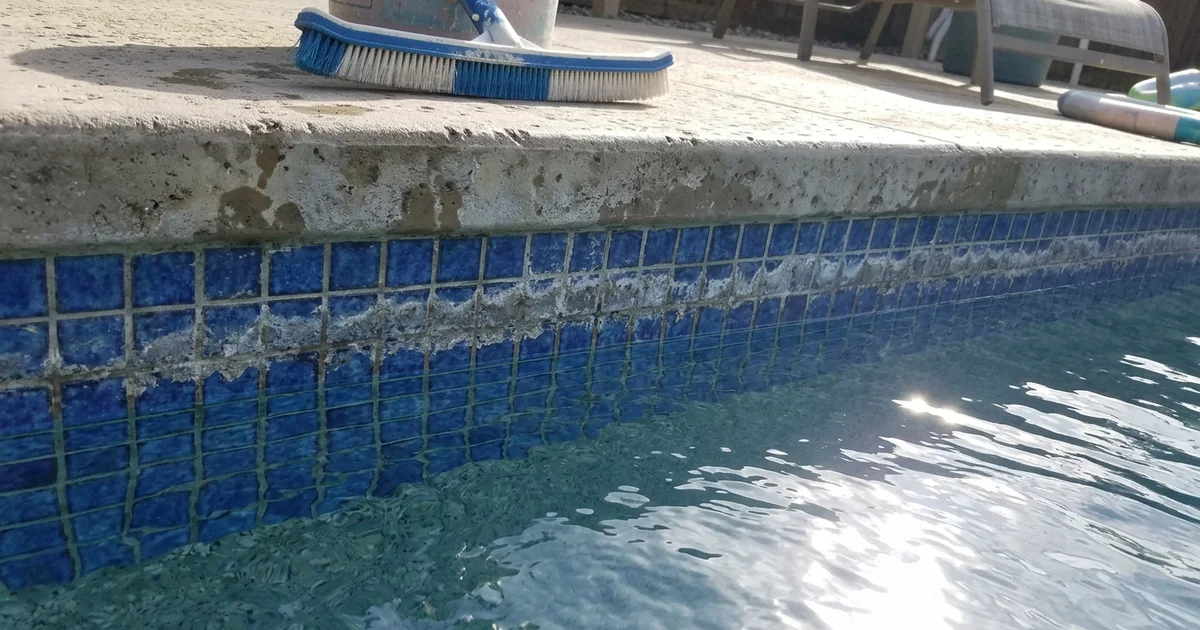
What Is the White Crust on My Pool Tile?
The white or gray crust along your waterline is calcium scale. It forms when minerals dissolved in pool water come out of solution and stick to the tile, usually right where the water evaporates.
White buildup on pool tile is close to universal in Southern California. Orange County tap water commonly runs somewhere between 8 and 19 grains per gallon depending on the city, and summer evaporation keeps concentrating it. Nearly every pool here develops some calcium on pool tile over time.
Knowing which kind you have decides how it comes off. That’s why identification is the first step of every pool tile cleaning job we do.
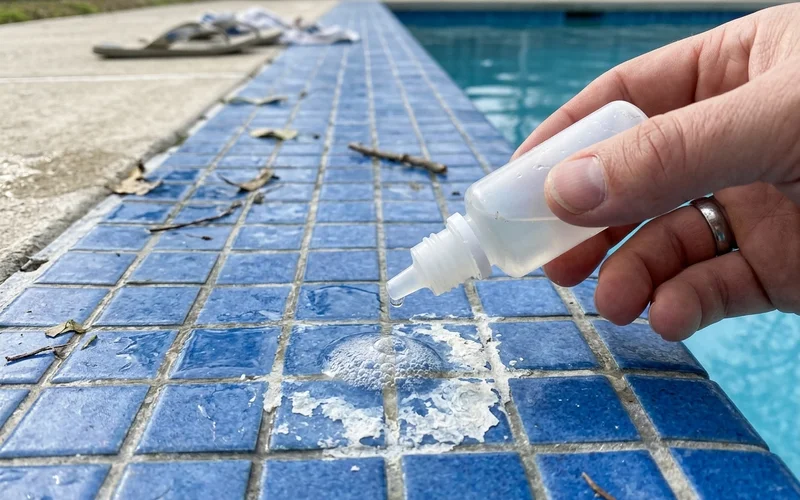
Calcium Carbonate: Flaky and Fizzy
Calcium carbonate is the more common and easier type to remove. It looks white and chalky, often forms in flaky layers, and builds up faster when pH runs high.
The good news is that it reacts with acid. A drop of diluted acid makes it fizz and soften. It usually comes off with the right cleaner and some scrubbing, or a light pressure wash.
Most pool pros call carbonate the “catch it early” stage. Left alone, it can harden over the years into the tougher type below.
Calcium Silicate: Hard and Glassy
Calcium silicate is the tougher type. It’s often grayish, hard and glassy, and it builds slowly over years. It doesn’t react with acid the way carbonate does, so acid-based cleaners barely touch it.
Removal takes more time and more aggressive mechanical methods. Those have to be matched carefully to your tile so you don’t damage the surface. For a heavy band of silicate, bead blasting is a common approach, and pool pros often quote it at roughly $5 to $10 per linear foot.
| Feature | Calcium carbonate | Calcium silicate |
|---|---|---|
| Look | White, chalky, flaky | Gray-white, hard, glassy |
| Acid test | Fizzes and softens | Little or no reaction |
| How fast it forms | Months | Years |
| Removal difficulty | Easier | Harder, slower |
The quick identification test
Put a drop of diluted muriatic acid or white vinegar on the scale. Fizzing means carbonate. No reaction means silicate. Wear gloves and eye protection, and rinse afterward.
Vinegar is milder, so a faint fizz is normal. Never mix acid with chlorine products, and always add acid to water, never the other way around.
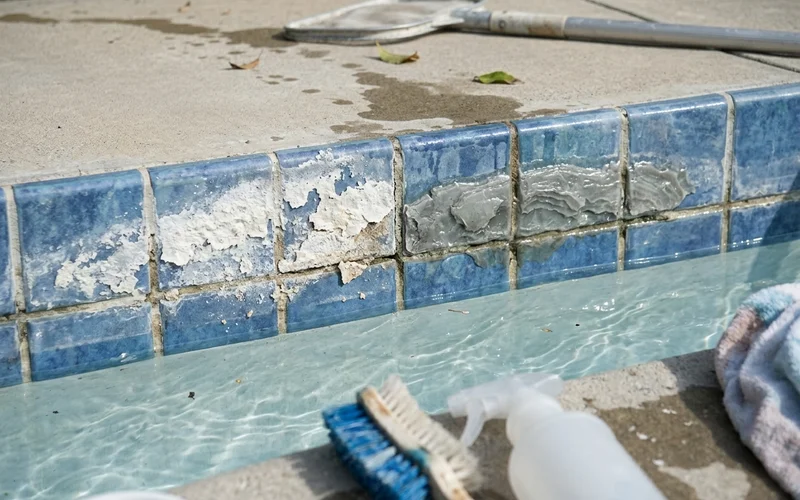
Why DIY Scraping Often Fails
DIY scraping works only on light carbonate scale. Many owners try a putty knife, scraper or pumice stone. On light carbonate over glazed porcelain, a pumice stone can do the job.
On silicate scale, scraping barely dents it and wears you out. On glass mosaic tile, scrapers and pumice can leave permanent scratches. And acid scrubbing does little against silicate while it can etch grout.
The other issue is the water line itself. Cleaning tile properly usually means lowering the water a few inches so you can reach the full scale band, then rebalancing afterward.
Here’s a quick way to decide whether to try it yourself:
- Fizzes and flakes in one small patch: a gentle DIY attempt on porcelain is reasonable.
- No fizz at all: skip the scraper and call a pro.
- Glass or mosaic tile: test a hidden spot first, or let a pro do it.
- Scale covers several feet of tile: professional cleaning saves time and tile.
Preventing the Crust From Coming Back
Scale returns when water chemistry favors it: high pH, high calcium, high total alkalinity and warm water. Keeping pH in range and brushing the tile line each week slows it noticeably.
Industry guidance puts the targets at a pH of 7.4 to 7.6, total alkalinity of 80 to 120 ppm and calcium hardness of 200 to 400 ppm. Many pros also check the Langelier Saturation Index, which combines pH, calcium, alkalinity, temperature and dissolved solids. A reading between -0.3 and +0.3 means the water is balanced, and anything well above that tends to deposit scale.
Our guide on Orange County hard water and pool tile scale explains the local factors.
If your crust doesn’t come off with a brush, a professional cleaning is the fastest way back to clean tile. We identify the scale type, test a small area and choose a method that’s safe for your tile.
Not sure which kind you’re looking at? Call Anaheim Pool Cleaners and we’ll take a look and give you a straight answer.