
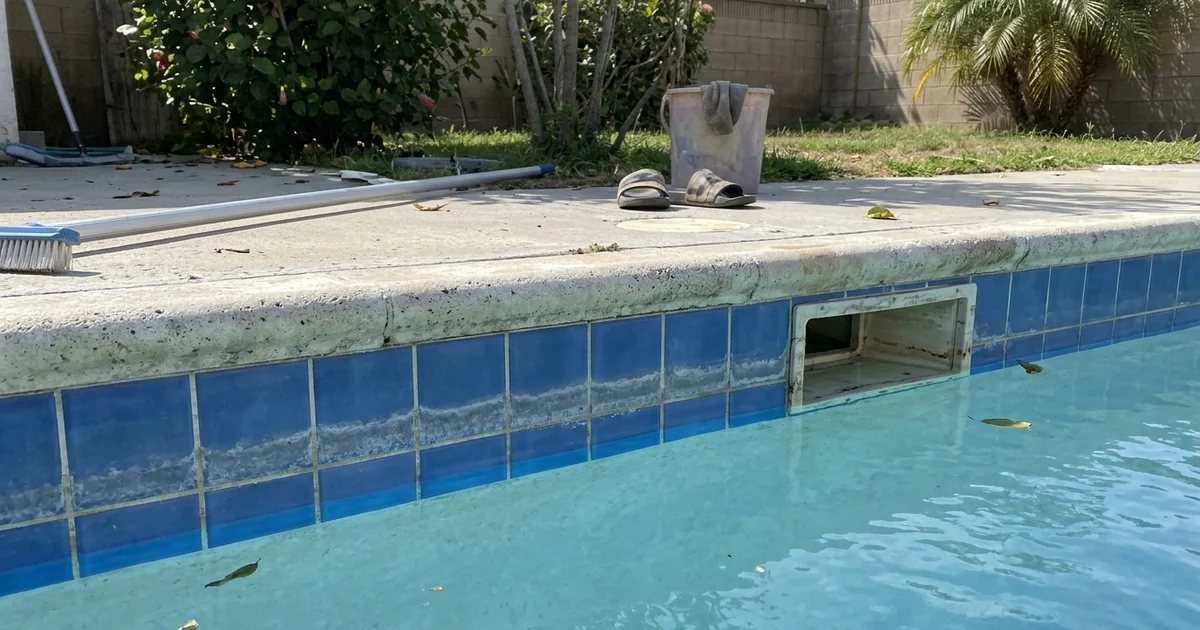
If your waterline tile keeps turning white no matter what you scrub, the water is the reason. North Orange County tap water is hard, our climate drives heavy evaporation, and every top-off adds more minerals to the pool.
Those minerals have nowhere to go, so they build up on the tile. That’s the classic hard water pool tile problem.
It’s also the most common reason homeowners in Anaheim, Placentia and Fullerton call us for pool tile cleaning. Below, we’ll cover where the minerals come from, how evaporation concentrates them, the chemistry that decides whether they stick, and what actually slows scale down.
Mineral-Rich Water in the Region
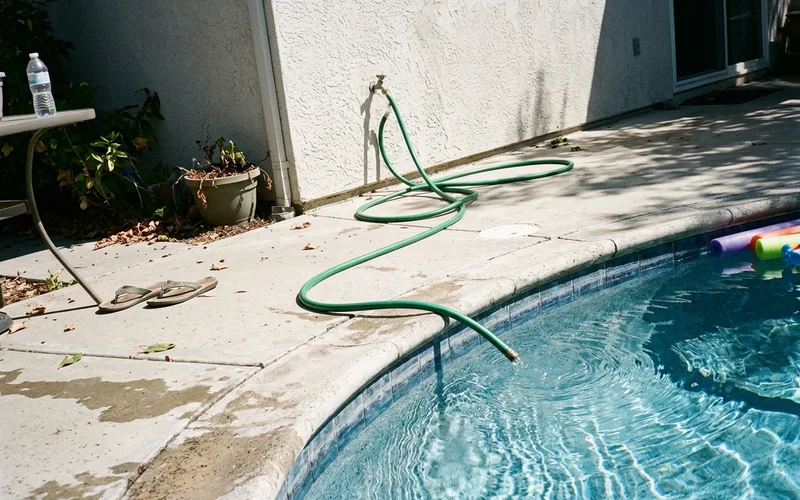
Our tap water is hard because it’s a blend of local groundwater and imported supplies. Imported water comes through the Metropolitan Water District from the Colorado River and Northern California. Local groundwater comes from an aquifer refilled by the Santa Ana River, rainfall and imported water.
Hardness is the dissolved calcium and magnesium in that water, and it’s measured in mg/L (or ppm) as calcium carbonate. Metropolitan’s own source water has run from roughly 80 to 300 mg/L depending on the source and the season. Anything above about 180 mg/L counts as very hard, so most of North Orange County sits at or above that line for much of the year.
Your exact number depends on your city and the month. It’s high enough almost everywhere here to cause calcium buildup in a pool.
Evaporation and Top-Off Cycles
The real problem is concentration, not the tap water alone. Here’s the cycle:
- Hot sun, dry air and wind evaporate water from the pool.
- Evaporation removes pure water but leaves the minerals behind.
- You top off with more hard tap water, adding more minerals.
- Repeat all summer, every summer.
The California Spa and Pool Industry Education Council puts normal evaporation at a half inch to two inches per week. An uncovered inland pool in July sits at the high end of that range. Losing even an inch a week means you’re replacing a few hundred gallons of water that took none of its minerals with it.
Over time, calcium hardness and TDS (total dissolved solids) climb. Many local pools hit the point where the only real fix is a partial drain and refill.
Why the tile and not the floor?
At the waterline, water evaporates and splashes dry on the tile again and again. Each cycle leaves a thin mineral film, and those films stack into a crust.
High pH and the LSI
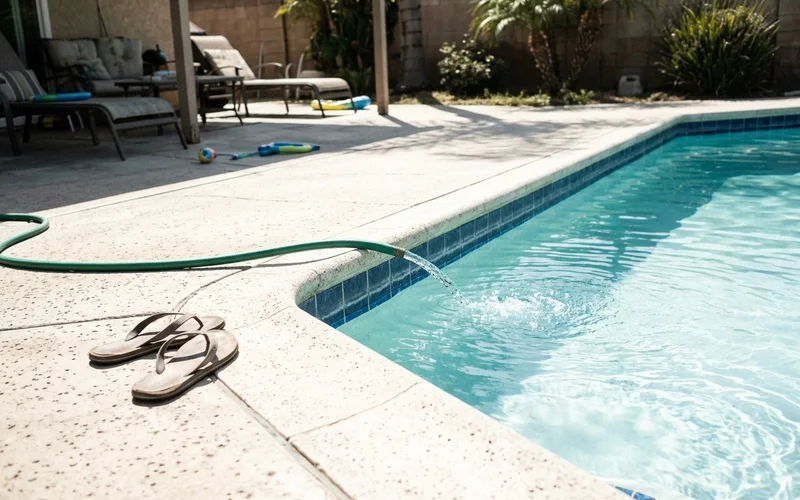
High pH is what turns hard water into visible scale. Calcium only crusts onto tile when the water is oversaturated, meaning it holds more calcium than it can keep dissolved.
Pool pros measure this with the Langelier Saturation Index (LSI). It combines pH, total alkalinity, calcium hardness, water temperature and TDS into one number. Near zero is balanced. When the LSI runs positive, scale forms. Our guide on pool chemistry levels explains the targets.
| Factor | Effect on scale | Typical target |
|---|---|---|
| High pH | Strongly increases scaling | 7.4 to 7.6 |
| High total alkalinity | Pushes pH up, increases scaling | 80 to 120 ppm |
| High calcium hardness | More calcium available to deposit | 200 to 400 ppm |
| Warm water | Calcium is less soluble, more scaling | Can’t control it, so manage the rest |
| High TDS | Adds to mineral load over time | Climbs with every top-off |
Salt pools tend to run higher pH, which is why they scale even faster. Once alkalinity creeps above about 175 ppm, pH gets hard to hold in range, and the tile line pays for it.
Prevention: Chemistry Plus Periodic Cleaning
You can’t change the water supply, but you can slow scale down. The most effective moves:
- Keep pH in range. This is the single biggest lever. Aim for 7.4 to 7.6.
- Watch alkalinity and calcium. Don’t let alkalinity drift past 120 ppm or calcium hardness past 400 ppm.
- Brush the tile line weekly. Removing the film before it hardens helps a lot.
- Use a cover to reduce evaporation and top-offs.
- Plan on periodic deep cleaning. Even well-balanced hard-water pools build some scale over a year or two.
Weekly service handles the chemistry and tile brushing. When scale does build, we remove it with a method matched to your tile, whether that’s glass, ceramic or natural stone.
If your tile line is already crusted, or you’d rather stop the cycle before it starts, reach out to our team. We’ll check your numbers and set up a plan that fits your pool.