
Sooner or later, every property manager and HOA board asks the same thing. Should we run the pool with our own people, or hire it out?
Both routes can work.
The right choice depends on how many pools you run, whether staff have the training and time, how you handle liability, and who covers weekends and emergencies. At Anaheim Pool Cleaners, we see many properties land on a hybrid.
Here’s how to weigh in-house vs contracted pool maintenance, and where commercial pool service fits in. We’ll cover training, liability, coverage, equipment and cost.
Training and Certification
Running a public pool takes trained people. California’s Title 22 (Section 65521) requires every public pool to operate under the supervision of a pool operator.
Many properties want staff to hold a recognized credential, such as the Certified Pool Operator (CPO) certification from the Pool & Hot Tub Alliance. The course costs time and money, and the certification expires after five years, so renewals come back around.
A trained operator needs to know:
- Water chemistry and how to correct it
- Title 22 rules and recordkeeping
- Safety equipment and how to inspect it
- Pump, filter and chemical feeder care
When trained staff leave, the knowledge goes with them. Turnover is one of the biggest hidden costs of in-house pool care.
Liability and Chemical Storage
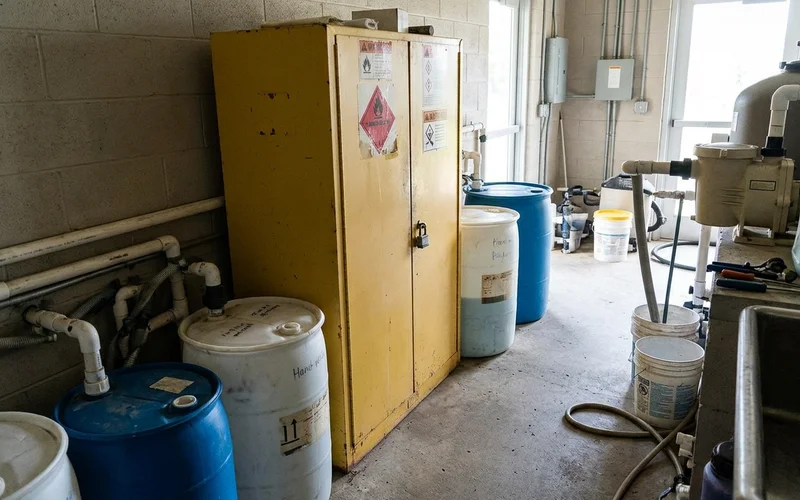
In-house care puts the chemical risk on your property. You store and handle chlorine, acid and other chemicals on site, which takes proper storage, ventilation, safety gear and training.
Mistakes can injure staff or swimmers. They can also leave the water out of range, and the numbers are specific:
- Free chlorine of at least 1.0 ppm, or 1.5 ppm if you use stabilizer
- Combined chlorine under 0.4 ppm
- pH between 7.2 and 7.8
A licensed, bonded and insured contractor brings the chemicals, handles them safely and carries insurance for their work. Ask for a certificate of insurance before you sign. HOA industry guidance recommends it, and it’s the quickest way to see who actually carries the risk.
Coverage on Weekends, Holidays and Emergencies
A contractor with 24-hour availability is the simplest fix for the weekend gap. Pools don’t take holidays, and Title 22 calls for daily testing of the disinfectant level at most public pools, even on a long weekend.
A pump that fails on the Fourth of July or water that clouds up on a Saturday needs attention right away. With in-house staff, those moments often land on someone’s day off.
The hybrid most properties choose
Staff handle daily testing, logs and walkthroughs. The contractor handles professional visits, chemistry, cleaning and equipment repair.
Equipment Expertise
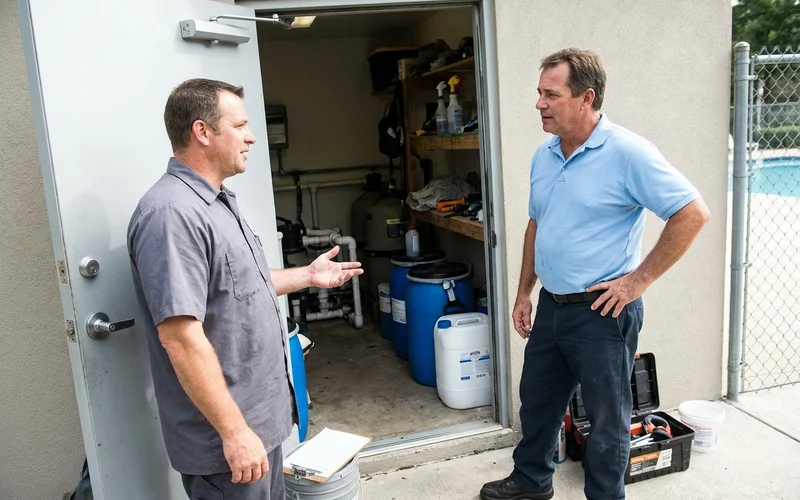
A contractor that services and repairs equipment keeps everything under one vendor. Diagnosing a failing pump, a leaking filter or a flow problem takes experience.
In-house staff often call a repair company anyway. That means two vendors, more back and forth and slower fixes.
One-vendor service matters for chemistry too. When circulation drops, chlorine stops spreading evenly, and the water can slip out of range while you wait on a part.
Total-Cost Comparison Framework
For most single-pool and small multi-pool properties, contracting is the more predictable option. Here’s the side-by-side.
| Cost factor | In-house | Contracted |
|---|---|---|
| Labor and wages | Staff time, overtime | Included in contract |
| Training and certification | Your cost, repeated with turnover | Contractor’s responsibility |
| Chemicals | Purchased and stored on site | Often included |
| Equipment repair | Usually a second vendor | Same team |
| Weekend and emergency coverage | Overtime or gaps | Included or on call |
| Liability exposure | Higher | Shared with an insured contractor |
If you go that route, our HOA pool service contract checklist covers what to require.
Still sorting out an HOA pool contractor vs staff for your property? Tell our Anaheim team about your pool, and we’ll help you decide whether to outsource pool maintenance or build a hybrid.