
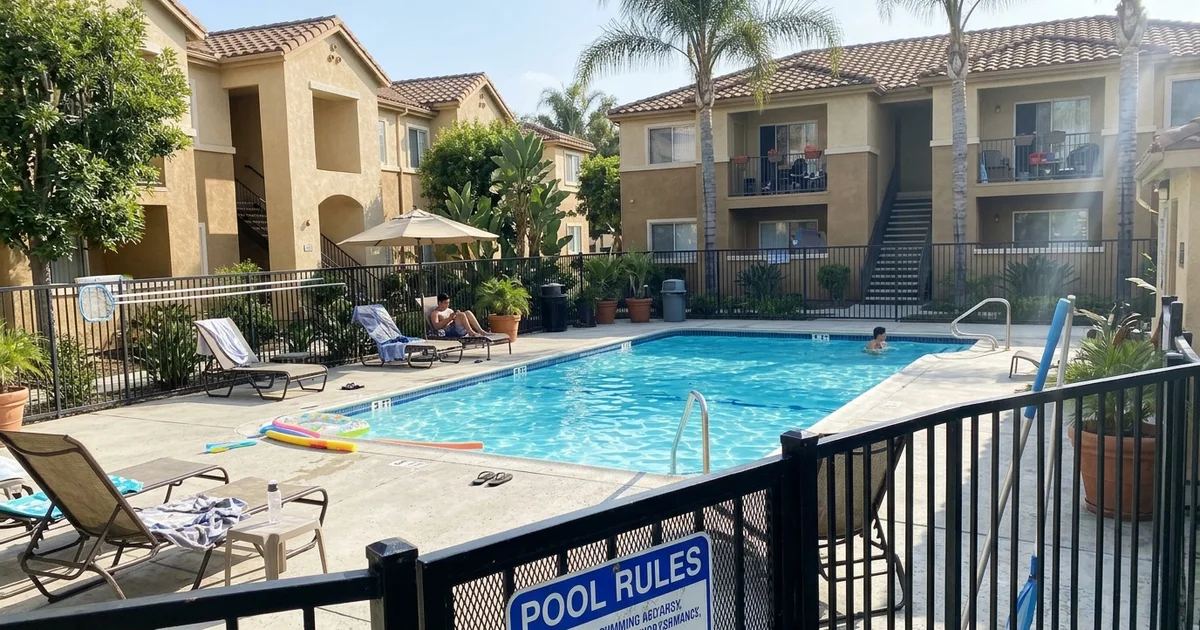
California Title 22 Pool Requirements Explained
You know how a pool inspection always seems to sneak up on a property manager? Most of that stress comes from not knowing exactly what the rules say.
California Title 22 is the state rulebook for operating and maintaining public pools. It sits in Division 4, Chapter 20 of the California Code of Regulations. If you manage an HOA, condo, apartment, hotel or similar shared pool, it almost certainly applies to you.
It’s less complicated than it looks.
The rules cover water quality, record-keeping, safety equipment, signage and upkeep. Our team at Anaheim Pool Cleaners uses this framework for every commercial pool service account. Rules change, so always confirm current requirements with your local health agency.
Here’s who Title 22 covers, the water and log numbers inspectors check, the signs and gear you need on deck, how permits work in our area, and where a service provider fits in.
Who Title 22 Covers
Title 22 covers almost any pool that isn’t at a single-family home. “Public pool” in California means far more than city pools. Here are the common examples:
- HOA and condo community pools and spas
- Apartment complex pools
- Hotel and motel pools
- Mobile home parks, clubs and fitness facilities
- Schools and camps
Many HOA boards assume a “residents only” pool counts as private. It doesn’t. If residents or guests share your pool, assume it’s covered until your health agency tells you otherwise. That’s the safest reading of California public pool regulations, and it’s the one inspectors use.
Water Quality Ranges and Daily Logs
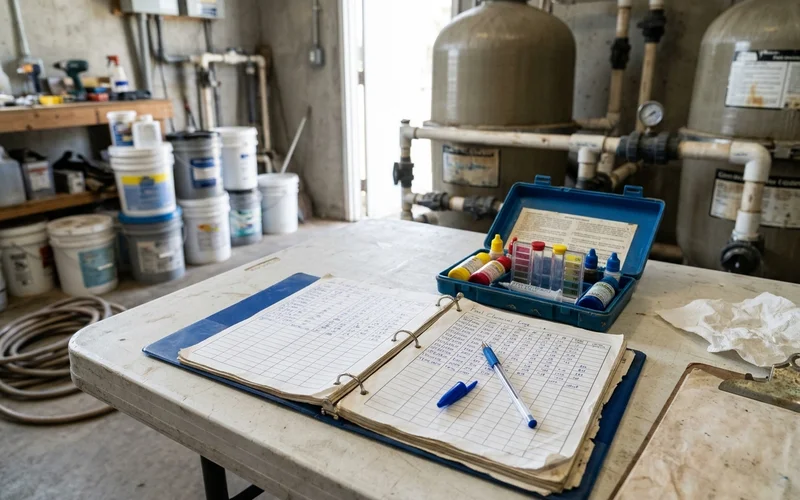
Title 22 sets minimum and maximum levels for sanitizer, pH and stabilizer. It also requires water clear enough to see the main drain from the deck. The facility must test the water and keep written records, and daily logs for chlorine and pH are commonly expected.
The chlorine minimum depends on whether you use stabilizer (cyanuric acid, or CYA). Most county guidance lists 1.0 ppm free chlorine for pools without CYA and 2.0 ppm for pools with it. Spas and wading pools need at least 3.0 ppm. The maximum for all of them is 10 ppm.
| Area | What’s typically required |
|---|---|
| Sanitizer | Free chlorine at 1.0 ppm minimum without CYA, 2.0 ppm with CYA, and 3.0 ppm in spas. Maximum 10 ppm. |
| pH | Between 7.2 and 7.8 |
| Stabilizer (CYA) | No higher than 100 ppm, and tested at least monthly if you add it |
| Clarity | Main drain clearly visible from the deck |
| Records | Test results and maintenance logged and kept on site for two years |
Logs matter as much as chemistry
A pool with perfect water but missing logs can still get written up. Inspectors want to see that testing happens consistently, not just on inspection day.
Two years of records is a long paper trail. A binder with gaps in it tells an inspector more than one good reading does.
Signage, Safety Equipment and Gates
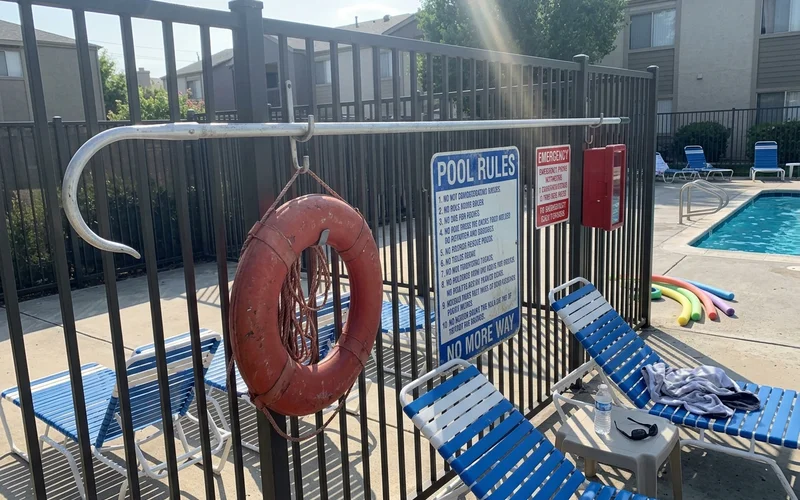
Public pools need posted signs, rescue gear within reach and gates that close and latch on their own. Signs commonly include pool rules, no-lifeguard notices, emergency instructions and occupancy limits.
Section 65540 of Title 22 spells out the rescue gear:
- A life ring (ring buoy) at least 17 inches across
- A throw rope of at least 3/16-inch diameter, long enough to span the pool’s widest point
- A rescue pole (shepherd’s crook) at least 12 feet long
- A second set on the opposite side if the pool is over 75 feet long or 50 feet wide
Store the rope so it can’t kink or tangle. The code calls for that, and a tangled rope is a quick write-up.
Gates and fencing must meet requirements, including self-closing and self-latching gates. Drain covers must meet federal anti-entrapment rules. Our guide on VGB-compliant drain covers covers that piece.
Permits and the Local Health Agency
Public pools need an operating permit from the local health agency, which also performs inspections. In most of our service area, that’s the Orange County Health Care Agency’s Environmental Health Division. Along the county line in La Mirada, Cerritos and Whittier, it’s the LA County Department of Public Health.
Both enforce state rules but may have local procedures, fees and inspection schedules. Orange County’s 2025-26 fee schedule shows what that can mean in dollars:
| Orange County item | Fee |
|---|---|
| Annual operating permit | $429 per body of water |
| Notice of Violation | $376 |
| Re-inspection | $125 per hour |
A pool and a spa count as two bodies of water, so budget for two permits. Fees can change each July, so check the county’s current schedule. Our Orange County pool health inspection checklist explains what inspectors look for.
How a Service Provider Helps
The property owner is responsible for compliance, but a good service provider makes meeting Title 22 pool requirements much easier. We keep chemistry in range between visits and leave consistent service notes. Our technicians also check safety equipment and drain covers on routine visits and flag problems before an inspector finds them.
Consistent notes also help with the two-year record rule, since your paper trail builds itself.
If your current setup feels like a scramble before every inspection, a steadier schedule and better records usually fix that. Reach out to us for an HOA pool requirements walkthrough in California before your next inspection, and we’ll show you exactly what to tighten up.