
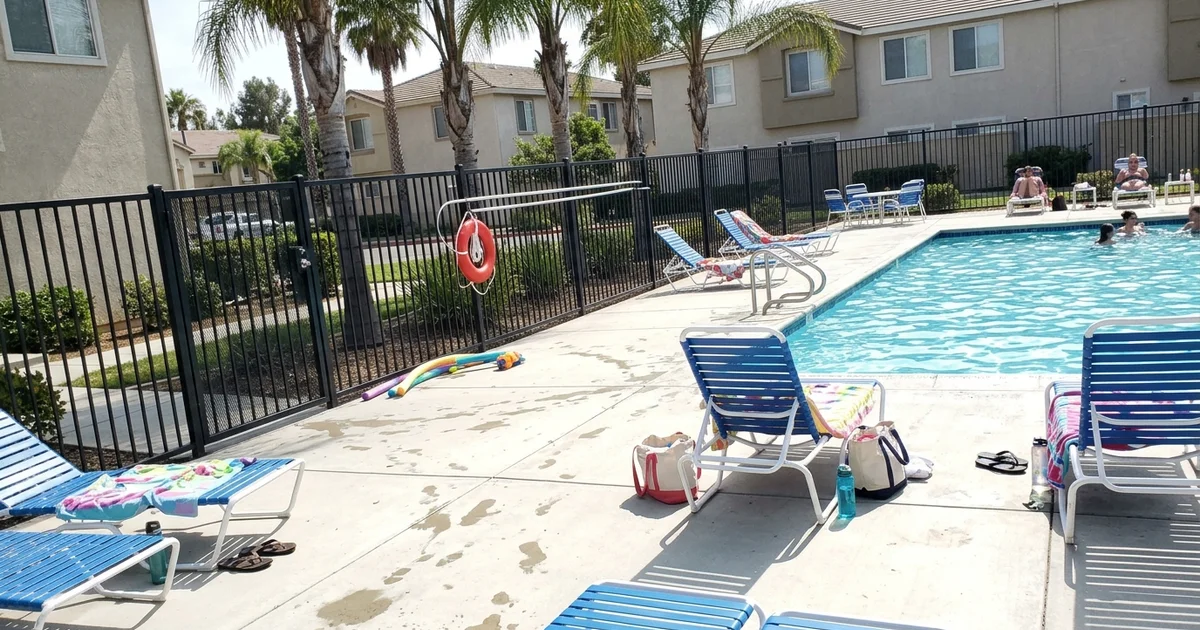
Orange County public pools, including HOA, apartment and hotel pools, are permitted and inspected by the Orange County Health Care Agency’s Environmental Health Division. Inspections are often unannounced, so a last-minute cleanup rarely works.
The goal is a pool that’s inspection-ready every day.
Here’s a practical OCHCA pool inspection checklist, based on what we keep on top of for our commercial pool service accounts. Under California’s Title 22 pool rules, a violation that creates an imminent health hazard can get a pool closed, so the stakes are real. Always confirm current requirements with OCHCA.
Below, we’ll walk through chemistry and logs, gates and signs, water clarity and the equipment room, the most common write-ups, and where a service provider fits in.
Chemistry and Daily Logs
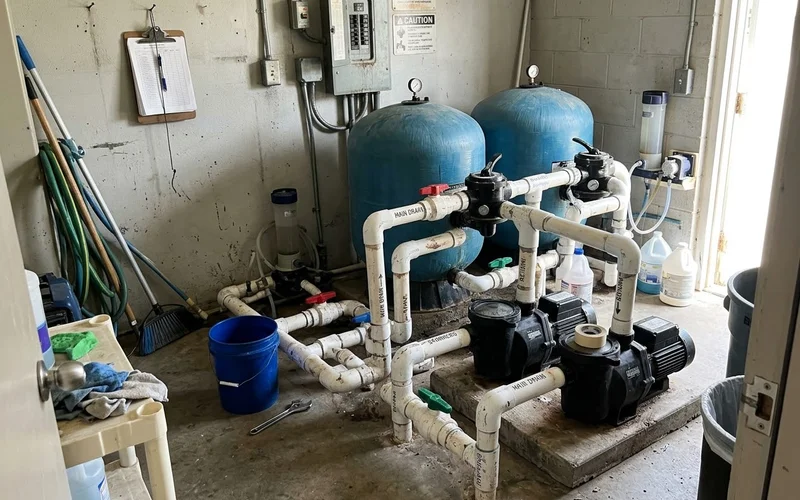
Inspectors typically start with the water and the records. Have sanitizer, pH and stabilizer in range, and keep a complete daily log on site.
- Sanitizer: Title 22 sets a minimum free chlorine of 2.0 ppm if the pool uses cyanuric acid (CYA), or 1.0 ppm if it doesn’t
- pH: Within the required 7.2 to 7.8 range at the time of inspection
- Stabilizer (CYA): Below the 100 ppm maximum, and tested at least once a month with the result written down
- Daily logs: Regular testing, filled in consistently and kept on site
- Test kit: On hand, in date and in working order
Gaps in the log, made-up-looking numbers or a missing log binder are common write-ups even when the water itself is fine. California’s operation records rule (Title 22, Section 65523) calls for a written daily record of test results, equipment readings and corrective actions.
Here’s the pro tip we give every property manager. If a reading is off, write down what was done to fix it. An inspector who sees a problem and a documented correction reads that very differently from a problem with no explanation.
Gates, Signage and Safety Items
Inspectors walk the whole perimeter, not just the water. Gates, fencing, signs and rescue gear all get a look.
| Item | What to check |
|---|---|
| Gates | Self-closing and self-latching, latch at the right height, no propped gates |
| Fencing | No gaps, damage or climbable furniture against it |
| Signs | Required rules, emergency and no-lifeguard signs posted and readable |
| Safety equipment | Ring buoy with rope and rescue pole in place |
| Drain covers | In place, undamaged and within their certified life |
| Depth markers | Visible and intact |
Drain covers deserve extra attention. The federal Virginia Graeme Baker Pool and Spa Safety Act requires public pools to have anti-entrapment covers that meet the ASME/ANSI A112.19.8 standard, and California folded those rules into state law. A cracked or expired cover is an easy write-up and a real entrapment risk.
Our guide on California Title 22 pool requirements explains where these rules come from.
Walk the gate every week
A gate that doesn’t latch on its own is one of the most common and easiest write-ups to avoid.
Water Clarity and Equipment Room Condition
The main drain must be clearly visible from the deck. Cloudy water is a serious violation and can close the pool.
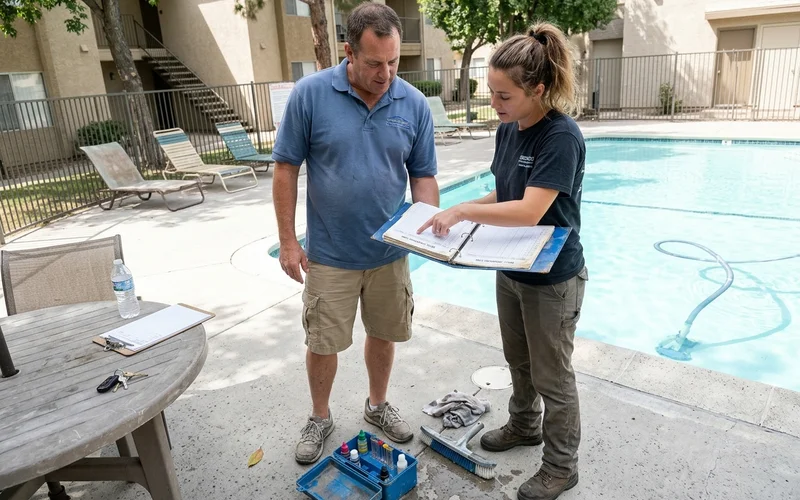
Inspectors may also look at the equipment area. Here’s what they tend to check:
- Pump and filter running
- Flow and pressure gauges working
- Chemicals stored safely
- Area reasonably clean
A quick walk through the equipment room at the start of each week catches most of these before anyone else does.
Common Write-Ups
Most failed inspections come down to the same short list. Fix these and you’ve covered the bulk of the risk.
- Missing or incomplete daily logs
- Sanitizer or pH out of range
- Cloudy water with the main drain not visible
- Gates that don’t self-close or latch
- Missing or faded signs and missing safety equipment
- Damaged or expired drain covers, and broken tiles with sharp edges
Several of these can lead to a closure. Our guide on why commercial pools get closed goes deeper.
Inspections don’t always start with a scheduled visit. Anyone can report an unsafe or unsanitary pool to OCHCA’s Environmental Health Division at 714-433-6000, so a green or cloudy pool can bring an inspector to your gate.
How a Service Provider Keeps You Ready
A provider can’t fill in your daily logs for you, but they can make passing much easier. Here’s what we do between inspections to keep your commercial pool inspection checklist covered:
- Keep chemistry stable between visits
- Leave clear service notes your staff can reference
- Check gates, signs, safety equipment and drain covers during routine visits
- Fix equipment problems quickly
When something needs the owner’s attention, we tell you before the inspector does.
Want your next Orange County pool health inspection to be a non-event? Ask us for a walk-through using this checklist, and we’ll show you exactly what an inspector would see.