
What a Weekly Pool Service Visit Should Include
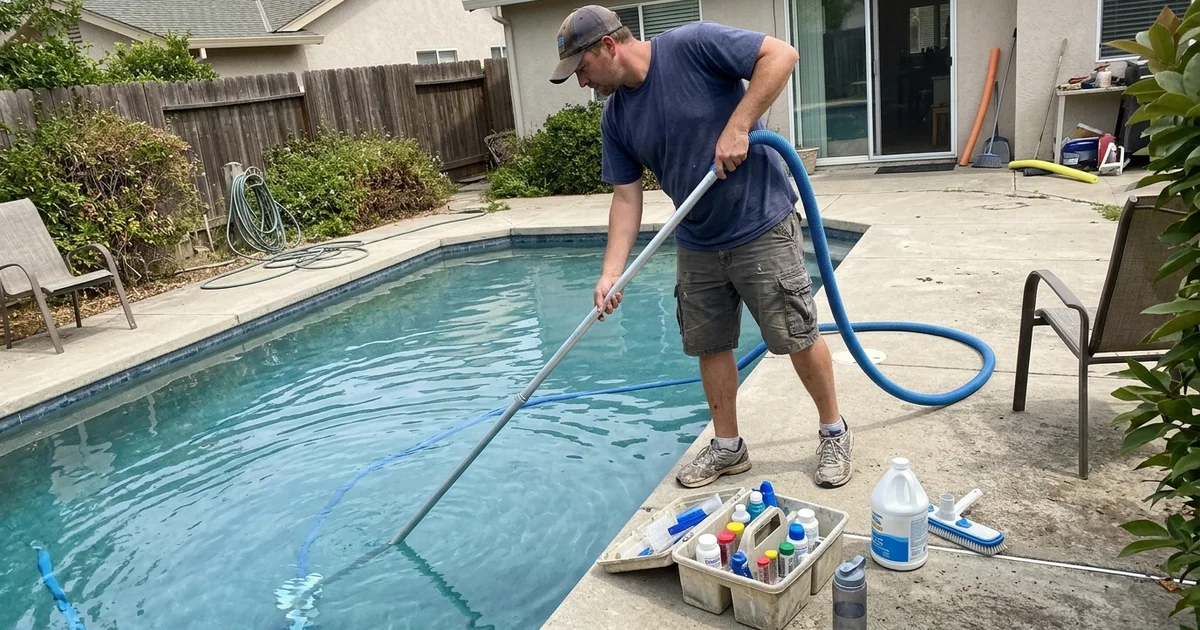
A complete weekly pool service visit covers four things: water chemistry, cleaning, equipment checks and communication. If any of those are missing, you’re not getting the full service.
Most homeowners never see what happens during a visit, so it’s hard to compare providers. That’s the gap this page fills.
Here’s exactly what our weekly pool service includes, so you can use it as a checklist. We’ll start with the visit itself, then cover what’s billed separately, how good communication looks, and the red flags to watch for.
The Weekly Visit Checklist
Every weekly visit should cover the ten tasks below. Industry guides commonly put a thorough visit at 30 to 60 minutes, depending on pool size and condition.
| Task | What it involves | Why it matters |
|---|---|---|
| Test the water | Free chlorine, pH, alkalinity, stabilizer, calcium | Catches drift before it becomes a problem |
| Balance chemicals | Add chlorine, acid or other chemicals as needed | Keeps water safe and protects plaster |
| Skim the surface | Remove leaves and floating debris | Debris uses up chlorine and stains plaster |
| Vacuum the floor | Remove settled dirt and debris | Keeps the pool clean and reduces algae food |
| Brush walls and steps | Brush the whole surface | Breaks up algae before it takes hold |
| Empty baskets | Skimmer and pump strainer baskets | Keeps flow strong and protects the pump |
| Check water level | Top off if it’s low | Prevents the pump from pulling air |
| Brush the tile line | Wipe the waterline | Slows calcium scale buildup |
| Check equipment | Pump, filter pressure, valves, visible leaks | Spots problems early |
| Leave visit notes | What was done and anything to watch | Keeps you informed |
On pools with a spa, the spa gets tested, balanced and cleaned too. If you have an automatic pool cleaner, we check that it’s moving and empty its bag or canister.
What “In Range” Means for Water Testing
Testing only helps if the tech knows the target. The CDC puts pool pH between 7.0 and 7.8, with 7.4 to 7.6 as the sweet spot. It also calls for at least 1 ppm of free chlorine, or 2 ppm when you use stabilizer.
For the other readings, the common residential targets look like this:
| Reading | Typical target |
|---|---|
| Total alkalinity | 80 to 120 ppm |
| Stabilizer (cyanuric acid) | 30 to 50 ppm, kept below 100 ppm |
| Calcium hardness | 200 to 400 ppm |
Stabilizer is the one that surprises people. It shields chlorine from sun, which matters under Southern California skies, but too much of it makes chlorine less effective.
Filter Pressure: The Quick Check That Saves Money
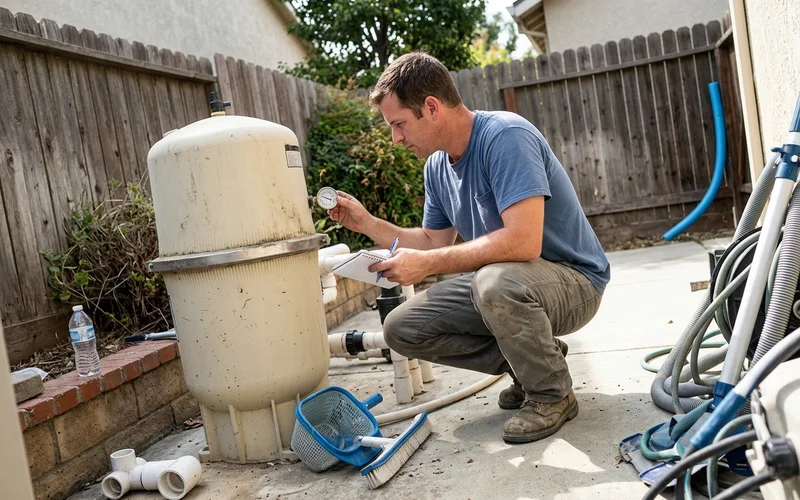
Filter pressure is the equipment check that pays off most often. When the gauge climbs 8 to 10 PSI above the clean starting pressure, the filter needs cleaning. Catching that early protects the pump from working against a clogged filter.
The two tasks that get skipped most
Brushing and the equipment check. Both take a few extra minutes, and both prevent the most expensive problems: algae blooms and surprise equipment failures.
What’s Usually Billed Separately
Some work falls outside a routine visit because it takes much more time or parts. With most providers, including us, these are quoted separately:
- Filter deep cleaning. Taking apart and cleaning a cartridge or DE filter, typically a few times a year.
- Green pool recovery. Clearing an algae bloom takes repeated shocking, brushing and filter cleaning over several days.
- Equipment repairs. Pump, motor and filter repairs or replacements.
- Tile cleaning and acid washing. Deep calcium removal and plaster restoration.
Knowing this up front makes quotes easier to compare. A low monthly price that excludes chemicals and skips brushing isn’t really cheaper.
Online, you’ll see weekly service advertised anywhere from about $129 to $210 or more per month, and the gap usually comes down to what’s included. Our guide on pool service cost explains what drives pricing.
Service Notes and Communication
A good pool service tells you what happened at your pool. After each visit, you should know that the visit happened, whether the chemistry was in range and if anything needs attention.
Useful visit notes usually include:
- Your readings. Chlorine, pH and the other tests, so you can see trends.
- What was added. The chemicals used and roughly how much.
- Equipment observations. A filter that’s due, or a pump that sounds rough.
That record also helps when something does go wrong, because it shows how the water and equipment were trending. If you manage a commercial pool, it matters even more, since county inspectors generally expect written chemistry logs.
Red Flags When Comparing Pool Services
Watch out for these signs that a provider is cutting corners:
- Rushed visits. Five minutes in and out isn’t enough time to test, clean and brush properly.
- No brushing. If the walls never get brushed, algae will eventually take hold.
- No chemistry records. If they can’t tell you your readings, they may not be testing.
- Baskets left full. A sign the visit was skipped or rushed.
- No mention of equipment. A tech who never notices a leak or a noise isn’t really checking.
- Unclear pricing. You should know whether chemicals are included.
We’d rather be compared on these points than on price alone. If you want a clear, written list of what your weekly pool service includes and what it costs, get a free estimate and we’ll walk through it with you.